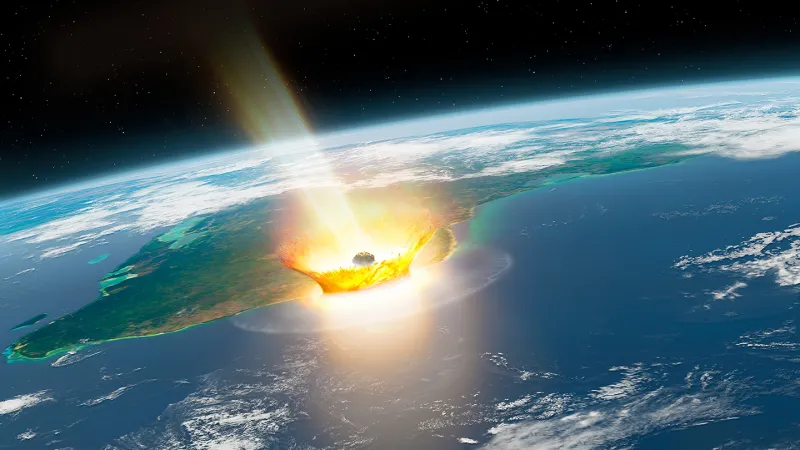
The timeline of the K-Pg extinction has always been a matter of intense debate. We knew a six-mile-wide asteroid struck the Yucatán Peninsula, but the precise killing mechanism, whether soot from global fires, sulfate aerosols, or impact winter, remained contested. This new research sharpens the picture by focusing on the immediate aftermath, proposing that fine dust ejected during the impact trapped heat in the upper atmosphere within minutes. The result is a rapid, global thermal pulse that may have killed non-avian dinosaurs before the cold and darkness set in. It is a compelling refinement of the classic model, and it changes how we think about the sequence of planetary trauma.
What strikes us as most consequential is the mechanism itself. The study argues that the very fine silicate dust, small enough to remain suspended for months, absorbed outgoing infrared radiation. That trapped heat created a short-lived but intense greenhouse spike. This is not a substitute for the broader understanding of the impact winter; it is a precursor to it. The distinction matters because it explains how a single event could produce multiple, sequential extinction pressures. We have a clear parallel in our own time with the Atlantic Circulation Weakens: Global Climate Reshaping Predicted, where a single system change triggers cascading regional effects. In the case of the dinosaurs, the atmosphere itself became the delivery mechanism for the first blow.
For our readers, the practical takeaway is about the fragility of the biosphere under rapid forcing. We are not talking about a slow shift over millennia, but a change that occurred within minutes to hours. This matters for how we evaluate current climate indicators. The Fossilized Poop Reveals Feathered Dinosaur Traits Linked to Survival shows that even subtle biological differences, like plumage, determined who lived and who died. That finding aligns with this new work: survival was not about size or strength, but about whether a species could tolerate an acute thermal spike. The dust did not discriminate by ecological niche; it discriminated by physiology.
The honest reaction here is that this should recalibrate our attention toward the short-term side of climate modeling. Most of our predictive tools focus on gradual warming, sea-level rise, and ocean acidification. But this research suggests that the most lethal phase of a major perturbation might be the first few hours. We would tell a reader who asks about this to watch for follow-up studies on the exact particle size distribution in the ejecta cloud. That measurement is the linchpin. If the dust was coarser than modeled, the heat pulse weakens; if finer, it strengthens. The Cascadia’s Subduction Zone Reveals a Fragmented Tectonic Process reminds us that Earth's systems are rarely as uniform as we assume. The same applies here: a single global average temperature change hides the fact that the atmosphere heated unevenly, and that unevenness likely dictated which species endured. The specific number to watch is not the peak temperature, but the duration of the heat spike. That is the detail that will decide whether this hypothesis solidifies into accepted science or remains a clever footnote.