environmental DNA
environmental DNA on World Data Ocean: a running collection of 18 stories we have gathered and hand-picked because they are worth your time. Every post here touches on environmental dna in some way — the news, the analysis, the deep dives, and the occasional surprise find. A Global Hub for Ocean Intelligence 4 World Data Ocean is a centralized digital platform where researchers, scientists, and ocean enthusiasts converge to explore, analyze, and… New stories are added to this page as we find them, so check back if you want to keep up with what is happening around environmental dna, or subscribe to the RSS feed to get them as soon as they are published. Browse the collection below, or head back to the homepage to see everything World Data Ocean is covering right now.

DP World Names Its First Methanol Dual-Fuel Vessel ‘DP World London’
DP World has launched its inaugural methanol dual-fuel vessel, the *DP World London*, marking a significant step toward sustainable maritime operations. Delivered at a ceremony in Aarhus, Denmark, this vessel represents Shipping Solutions’ commitment to reducing emissions within DP World’s Marine Services. The transition to methanol fuel demonstrates a proactive approach to environmental stewardship within the shipping industry. For broader context on ocean data collection efforts, see our related article on The Ocean Race Atlantic and its climate data initiatives.

Multiple lines of evidence framework for quantifying ecosystem function and connectivity of offshore infrastructure: a rigs-to-reefs perspective
Decommissioning of offshore oil and gas infrastructure presents a critical challenge, hampered by inconsistent monitoring and uncertainty regarding ecological impacts. Our research introduces a Multiple Lines of Evidence framework to quantitatively assess ecosystem function and connectivity associated with these structures, facilitating informed decision-making regarding removal versus habitat retention. Integrating diverse methodologies—from environmental DNA to biophysical modeling—this framework provides a transparent, context-specific basis for evaluating ecological value.
Unveiling deep-sea benthic biodiversity in the northern South China Sea through environmental DNA metabarcoding
A comprehensive environmental DNA (eDNA) metabarcoding study has revealed unprecedented insights into the benthic biodiversity of the northern South China Sea’s Qiongdongnan Basin, a region critical for natural gas hydrate resources. Researchers identified 334 benthic faunal species across cold seeps, gas hydrate stable zones, and non-gas hydrate zones, demonstrating clear habitat-specific community structures largely governed by deterministic processes like variable selection.
Beneath the surface: DNA metabarcoding reveals shifting biofouling patterns on marine artificial structures across season, depth, and substrate
Recent research illuminates the complex dynamics of marine biofouling, revealing how seasonal shifts, depth, and substrate type significantly influence community composition on artificial structures. Utilizing DNA metabarcoding across two seasonal periods and three depths, our study identified over 10,000 genetic variants, demonstrating that season explains the largest variation in biofouling biomass and diversity. These findings underscore the need for adaptive antifouling strategies considering interacting environmental factors—a perspective further explored in our related article, "Machine learning predictions for microbial eukaryotic plankton."
Environmental DNA reveals potential trophic links at male sperm whale foraging sites in Northern Norway
Machine learning, eDNA and citizen science in monitoring and assessing biodiversity and invasive alien species at sea
Emerging technologies are revolutionizing marine biodiversity and invasive alien species monitoring. This research, presented at a recent summer school, details the integration of machine learning, citizen science, and environmental DNA (eDNA) alongside remote sensing and drones. Machine learning, utilizing frameworks like Essential Biodiversity Variables (EBVs), enables efficient species identification and global data synthesis. Initiatives like iNaturalist exemplify the power of citizen science combined with AI validation.
Environmental DNA as a tool for ecosystem monitoring and conservation biology
Biodiversity loss presents a critical global challenge, demanding innovative monitoring solutions. Environmental DNA (eDNA) offers a transformative, non-invasive approach to ecological assessment. By analyzing DNA shed by organisms in soil and water, eDNA enables detection of rare species and provides ecosystem-level insights, revolutionizing conservation research. While advancements continue, rigorous calibration and validation remain essential.
Integrating environmental DNA and trawl surveys to assess seasonal dynamics of fish communities in the Oujiang River Estuary
Effective estuarine biodiversity monitoring faces challenges due to dynamic conditions and limitations of traditional methods. This study investigates the seasonal dynamics of fish communities in the Oujiang River Estuary (ORE) by integrating environmental DNA (eDNA) metabarcoding with conventional bottom trawling. Our analysis, encompassing 100 fish species across diverse families, reveals distinct seasonal variations and highlights the complementary strengths of each approach—eDNA excels at detecting pelagic and cryptic species, while trawling provides reliable abundance data.
Trends and hotspots in environmental epigenetics of aquatic invertebrates: a CiteSpace and VOSviewer-based bibliometric study
Understanding aquatic invertebrate responses to rapid environmental change is a critical challenge in marine ecology, increasingly addressed through environmental epigenetics. A recent bibliometric study, utilizing CiteSpace and VOSviewer, analyzed publications from 2014-2025, revealing a global research network characterized by methodological complementarity and collaborative partnerships. While China leads in publications and the United States drives network connectivity, current research emphasizes DNA methylation, a limited number of taxa, and often simplifies natural conditions.
Tracing species-specific kelp eDNA in marine sediments for blue carbon assessment along the Norwegian Coast
Marine ecosystems represent a crucial, yet understudied, component of global carbon sequestration. This research introduces a novel environmental DNA (eDNA)-based approach to trace *Saccharina latissima* and *Laminaria hyperborea* kelp species within Norwegian marine sediments, enabling improved blue carbon assessment. Utilizing species-specific qPCR assays across 79 sediment samples, we detected kelp DNA in 87% of locations, correlating strongly with sediment organic carbon. Notably, urchin grazing impacted areas showed reduced eDNA and carbon levels, highlighting the ecological link.
Host filtering shapes diversity and community stability of Symbiodiniaceae in Tridacna maxima across the Nansha Archipelago in the South China Sea
Recent research reveals a significant interplay between host filtering and Symbiodiniaceae community dynamics within *Tridacna maxima* across the Nansha Archipelago. High-throughput metabarcoding analysis demonstrates that giant clam symbionts exhibit markedly reduced diversity and increased stability compared to surrounding free-living communities. Dominated by *Cladocopium* C1 and *Symbiodinium* A3, these stable symbiotic communities suggest functional diversity within dominant genera may be crucial for holobiont resilience.
Diversity and distribution assessment of elasmobranchs in a shallow estuarine lagoon using environmental DNA
Recent research demonstrates the enhanced efficacy of environmental DNA (eDNA) for assessing elasmobranch diversity—a taxonomic group often difficult to study—within estuarine ecosystems. A study of Shinnecock Bay, a restored lagoon off Long Island, New York, revealed the presence of 12 unique elasmobranch species through eDNA analysis, significantly exceeding the four species identified by traditional benthic trawling. These findings highlight eDNA's value as a non-invasive, scalable tool for improved ecosystem assessments and informing management strategies for threatened elasmobranch populations.
Ever wonder how we actually track what’s living in the deep blue without catching every single fish? 🌊 Enter eDNA: envi...
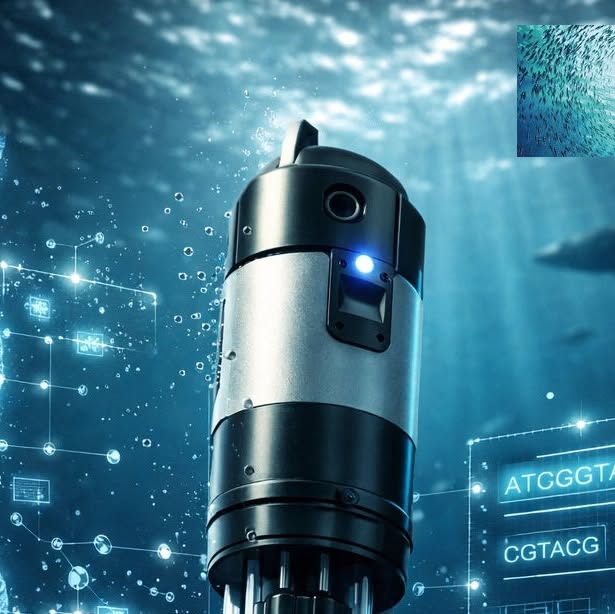
Have you ever wondered how we track marine life without catching every fish? Enter environmental DNA (eDNA), the ocean’s genetic footprint that is transforming our understanding of biodiversity. Once confined to research labs, eDNA is now empowering corporate leaders with validated, empirical data for ESG reporting. This shift enables companies to move beyond mere sustainability claims to measurable impact. At World Data Ocean, we bridge complex science with practical applications, making eDNA the gold standard for transparency in ocean stewardship.
Estimating genetic diversity of abundant oceanic dolphins through repeated environmental DNA sampling
Estimating the genetic diversity of oceanic dolphins presents challenges for researchers, particularly with traditional sampling methods. This study leverages environmental DNA (eDNA) metabarcoding to enhance the understanding of genetic diversity among abundant delphinids. By collecting 126 seawater samples during encounters with four common species near Santa Catalina Island, California, we utilized next-generation sequencing to identify mitochondrial DNA variants.

California Academy of Sciences secures grant to help endangered sea stars
The California Academy of Sciences has secured a grant from the California Ocean Protection Council to support its efforts in restoring endangered Sunflower sea stars, vital to coastal ecosystem balance. Marine researchers are pioneering innovative techniques, including environmental DNA (eDNA) monitoring, to track surviving populations and identify genetic traits that could enhance resilience against sea star wasting disease. As part of this initiative, volunteers will assist in shoreline surveys, contributing to a comprehensive approach aimed at reviving this critical species and fostering ocean health.
Integrative assessment of fish diversity in abalone raft culture areas of the Pingtan Sea, China, based on traditional fishing and eDNA metabarcoding
This study investigates the integrative assessment of fish diversity in abalone raft culture areas of the Pingtan Sea, China, amidst the growing global expansion of offshore aquaculture. By combining traditional fishing methods with environmental DNA (eDNA) metabarcoding, researchers conducted surveys from March to August 2024 to compare fish diversity between a raft culture area (RA) and a control area (CA).
how did you personally get your first job in this field?
Navigating the path to a career in marine biology can be challenging, especially for recent graduates. Having a Bachelor’s in Environmental Sciences and a Master’s in Marine Biology provides a solid foundation, yet the transition from academia to employment often feels daunting. It's essential to explore entry-level opportunities that match your skills and experience, such as lab technician roles or field research assistants.

Ever wonder what’s actually swimming in those deep blue waters without having to catch a single fish? Welcome to the era...
Ever wonder what lies beneath the ocean's surface without needing to catch a single fish? Welcome to the era of 'Ocean CSI.' At World Data Ocean, we are harnessing the power of environmental DNA (eDNA) to transform our understanding of marine ecosystems. By deploying autonomous underwater vehicles (AUVs) to collect water samples, we can detect DNA traces from marine life, enabling us to identify rare species and monitor biodiversity trends in real-time.