World’s First Operational Ammonia Transport & Bunkering Vessel Enters Service
Our take
The recent commissioning of the *Shenghang Yongle*, the world’s first operational ammonia transport and bunkering vessel, represents a significant, albeit incremental, step toward decarbonizing global shipping. The conversion of an existing vessel, the FKAB Marine Design L21 ammonia carrier, showcases a pragmatic approach to implementing alternative fuels, a necessity given the escalating urgency of climate change and the maritime industry’s contribution to global emissions. Recent events underscore the vulnerabilities of maritime trade routes; the Ship Carrying 14 Indian Crew Members Attacked Off Oman Coast highlights the existing safety challenges, and the ongoing need for robust, sustainable, and secure maritime operations. This development, while focused on fuel technology, contributes to the larger conversation surrounding maritime safety and resilience. Furthermore, the Indian Prime Minister’s recent urging of Iran to Indian PM Urges Iran To Safeguard Freedom Of Navigation, Commercial Shipping And Seafarers Safety emphasizes the global need for secure and reliable shipping lanes, a factor directly impacted by the transition to new fuel sources and the infrastructure required to support them.
The shift to ammonia as a marine fuel is predicated on its potential as a zero-carbon fuel source, provided the production process itself utilizes renewable energy. While hydrogen is often touted as the ultimate solution, ammonia presents advantages in terms of volumetric energy density, making it more practical for long-distance shipping. The *Shenghang Yongle*'s bunkering capabilities are crucial; simply having access to ammonia is insufficient; a dedicated infrastructure for transferring the fuel to vessels is essential for widespread adoption. This vessel’s operation provides a valuable, real-time, empirical data point regarding the feasibility and logistical challenges of ammonia bunkering. The integrated data ecosystem required to manage such operations—monitoring fuel quality, tracking bunkering volumes, and ensuring safety protocols—will be critical for scaling this technology globally. The incident involving the Video: 5 Dead, Dozens Missing After Passenger Ferry Catches Fire Off Philippines serves as a stark reminder of the potential hazards associated with maritime operations, highlighting the need for rigorous safety standards and protocols when handling any fuel, including ammonia.
However, challenges remain. Ammonia is toxic and corrosive, necessitating significant investment in safety systems and crew training. The current production of ammonia is heavily reliant on fossil fuels, undermining its potential as a truly zero-carbon fuel. Achieving a closed-loop, renewable ammonia supply chain requires substantial advancements in green ammonia production technologies and significant infrastructure investment. The calibrated approach of converting an existing vessel, rather than constructing a new one from scratch, is a sensible strategy, allowing for iterative learning and refinement of operational procedures. Longitudinal data collected from the *Shenghang Yongle* will be invaluable in validating the performance of ammonia-fueled engines, assessing the environmental impact of ammonia combustion, and identifying potential safety concerns. The peer-reviewed publication of this data will be essential for building confidence and accelerating the transition to ammonia as a viable marine fuel.
Looking ahead, the success of the *Shenghang Yongle* will hinge on demonstrating the economic viability and operational safety of ammonia bunkering at scale. The development of standardized bunkering protocols and the establishment of a robust global network of ammonia production and distribution facilities are crucial next steps. The integrated nature of this transition – requiring collaboration between shipowners, fuel producers, port authorities, and regulatory bodies – emphasizes the need for a globally coordinated approach. A critical question remains: Will the initial investment costs associated with ammonia infrastructure and technology prove to be a barrier to widespread adoption, or will the long-term environmental and economic benefits outweigh the upfront expenses?
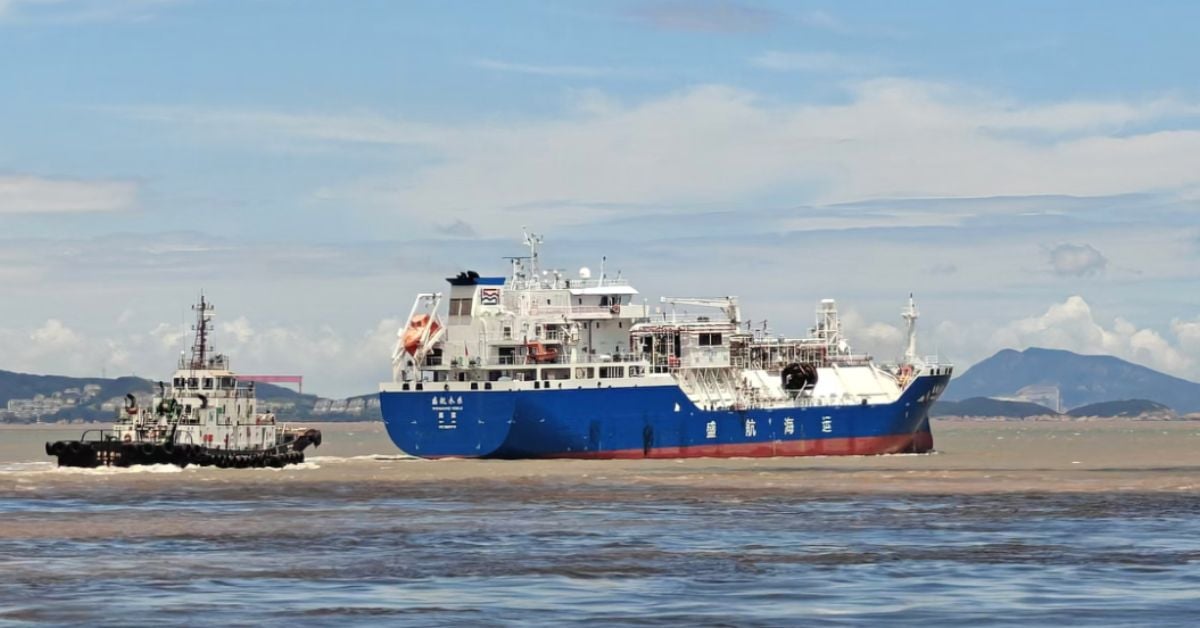
The FKAB Marine Design L21 ammonia carrier Shenghang Yongle has been converted for ship-to-ship liquid ammonia fuel bunkering.
Led by Jiangsu Andefu Energy Development, FKAB, together with cargo handling supplier Gloryholder, provided the technical drawing documentation for the conversion.
The vessel is now the world’s first operational ammonia bunker vessel and has received the first ammonia bunkering class certificate. The achievement marks an important step in developing the infrastructure needed to support ammonia as a marine fuel.
While several ammonia bunker vessel projects have reached the design, feasibility or construction stage, the Shenghang Yongle has now progressed into operational readiness.
Originally designed as a flexible liquefied gas carrier, the vessel has been upgraded from a conventional ammonia carrier into a dual-purpose vessel capable of both transporting liquid ammonia and delivering it as fuel through ship-to-ship bunkering.
A versatile platform for ammonia transport and bunkering
Shenghang Yongle is a 5,500 m³ semi-refrigerated and semi-pressurised liquefied gas carrier. The vessel was designed by FKAB, built by China Merchants Shipbuilding Industry Dingheng shipyard and is managed by Shenghang Shipping Co., Ltd.
Designed for unrestricted navigation, the vessel can carry several liquefied gas cargoes, including ammonia, LPG and vinyl chloride monomer. Its cargo tanks have a minimum design temperature of −48°C, and the vessel is equipped with two low-temperature reliquefaction systems.
These characteristics provided a strong technical foundation for the subsequent conversion. The vessel’s existing cargo containment and handling capabilities could be adapted to meet the additional requirements associated with transferring ammonia as a marine fuel.
From cargo carrier to bunker vessel
Jiangsu Andefu Energy Development led the conversion and certification process in close cooperation with China Classification Society, while FKAB, together with Gloryholder, prepared the technical drawing documentation required for the conversion. The overall work included modifications to the bunkering system, development of operating procedures, risk assessments, and the establishment of safety and emergency-response arrangements.
Particular attention was given to the challenges associated with ammonia, including toxicity, material compatibility, low-temperature operation, leak detection and risk control during bunkering.
Closing a critical infrastructure gap
Ammonia is regarded as one of the most promising potential zero-carbon marine fuels when produced using renewable energy. Its wider adoption, however, depends not only on ammonia-capable ships but also on a safe and reliable supply chain, including production, storage, transport and bunkering.
The lack of operational ammonia bunkering vessels has been one of the important gaps in this chain. The conversion of the Shenghang Yongle demonstrates how an existing ammonia-capable gas carrier can be developed into a practical bunkering asset.
Designed for today, adaptable for tomorrow
For FKAB, the project demonstrates both the long-term value of designing vessels with operational flexibility in mind and the importance of maintaining detailed knowledge throughout a vessel’s lifecycle. Having developed the original vessel design, FKAB was able to support its next stage by preparing the technical drawing documentation for the ammonia bunkering conversion.
Shenghang Yongle was designed and built as a capable, versatile working vessel. Its conversion into an ammonia bunker vessel shows how robust naval architecture, adaptable cargo systems and carefully developed conversion documentation can help turn the marine energy transition into operational reality.
Press Release
Read on the original site
Open the publisher's page for the full experience