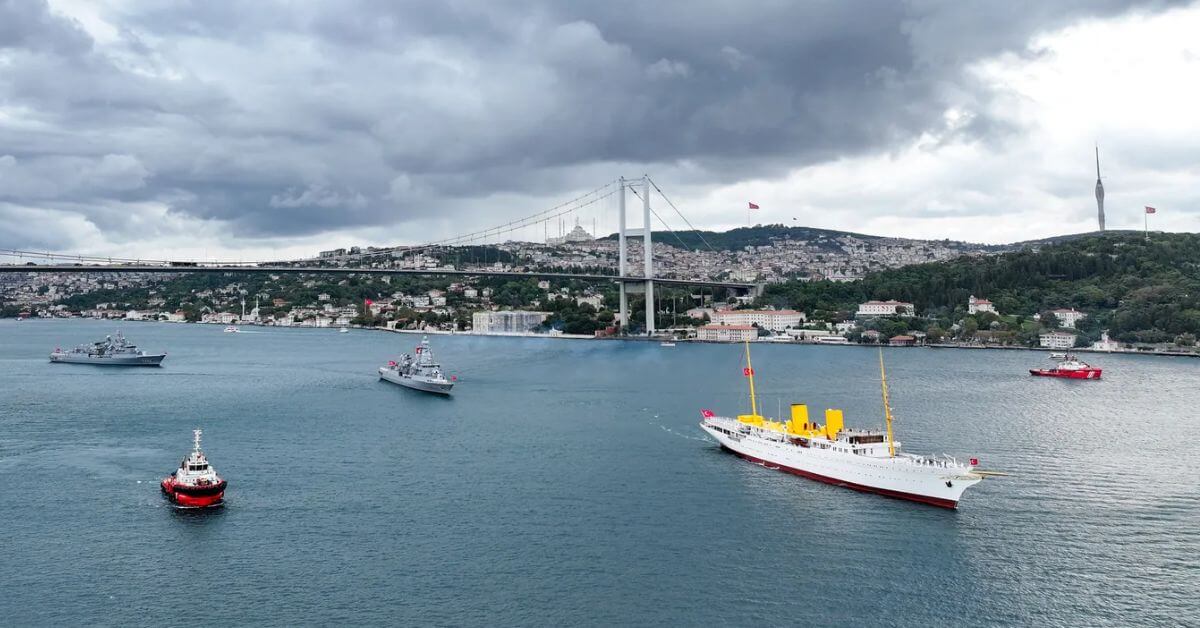
The Turkish Navy's parade of 15 warships through the Istanbul Strait to mark the 488th anniversary of the Preveza victory is a display of national capability, but for our readers who track maritime power and defense logistics, the centerpiece is the domestically designed frigate TCG Istanbul. This vessel represents a calibrated step in naval self-sufficiency, moving beyond assembly to true indigenous design and construction. In a region where maritime boundaries and energy corridors are under constant negotiation, a navy that can build its own principal surface combatant gains a measurable advantage in operational tempo and supply-chain security. That is not a symbolic achievement; it is a practical shift in strategic depth.
We see a clear parallel in the Validated long-range strike capability demonstrated in Arabian Sea test, where Pakistan's PNS/M Hangor struck a designated target at distance. Both events validate that regional navies are moving from platform acquisition to verified performance of homegrown systems. For analysts and policymakers, the takeaway is that empirical data from such tests, whether a frigate's sea-keeping or a submarine's weapon accuracy, provides the real-time intelligence needed to assess balance-of-power shifts. The TCG Istanbul is not merely a frigate; it is an integrated data point on a nation's ability to sustain blue-water operations without foreign dependency.
This is where our perspective diverges from a purely celebratory reading. Every warship parade makes a statement, but the more consequential story lies in what is not shown: the sensor suites, combat management systems, and maintenance cycles that determine whether a vessel can deploy for months at sea. The Turkish Navy's achievement is real, but it must be validated by longitudinal performance data. Similarly, the Tugboat emissions mapped along Trabzon terminal routes to assess coastal air quality study reminds us that naval operations have environmental fingerprints. A fleet of advanced warships brings with it increased fuel consumption, port infrastructure demands, and emissions that affect coastal communities. National pride in a new frigate should not obscure the need for integrated environmental monitoring of naval activity.
We would tell a reader who asks us about this parade to watch one specific metric: how quickly TCG Istanbul achieves full operational status and deploys on a sustained mission. The frigate's design is a proof of concept, but peer-reviewed reliability data from extended patrols will determine whether this is a one-off milestone or the foundation of a new shipbuilding ecosystem. The open question is whether Türkiye can replicate this success across a class of vessels, and whether its supply chain for sensors, propulsion, and combat systems remains resilient under geopolitical pressure. That is the concrete point to track, not the anniversary itself.