Small Ports Don’t Need Rotterdam’s Budget To Automate – Here’s What They’re Doing Instead
Our take
The narrative surrounding port automation has often been framed through the lens of massive investment and wholesale technological overhauls, exemplified by the sprawling infrastructure of ports like Rotterdam. However, the recent article highlighting the pragmatic approach of smaller ports offers a crucial recalibration of that perspective. The reality is that not every maritime hub possesses the resources or, indeed, the need for such extensive, immediate transformations. Asian Port Delays Cause Sharpest Drop In Global Vessel Reliability Since 2021 underscores the current pressures on global shipping, and smaller ports, often overlooked in broader discussions, are increasingly vital in mitigating those pressures through adaptable, targeted solutions. This shift away from a "one-size-fits-all" automation strategy recognizes the inherent diversity of port operations and the economic realities faced by smaller facilities. It's a move towards a more nuanced understanding of port efficiency – one that prioritizes incremental improvements and problem-specific technology over sweeping, potentially unsustainable, implementations.
The incremental approach described—focusing on one gate, one system, one problem at a time—demonstrates a practical understanding of resource allocation and risk management. Larger ports often face immense pressure to adopt cutting-edge technologies, even if the immediate return on investment is uncertain. Smaller ports, however, have the agility to experiment with targeted solutions, validating their effectiveness before wider deployment. This measured approach aligns with the principles of empirical observation and calibrated implementation – key tenets of robust scientific methodology. Furthermore, the recent incident 1 Dead, 6 Missing After Tugboat Sinks While Towing Container Ship Off Busan highlights the operational complexities and inherent risks within maritime environments. Targeted automation, addressing specific bottlenecks or safety concerns, can demonstrably improve efficiency while mitigating these risks more effectively than broad, untested overhauls. The data generated from these smaller-scale implementations can then be integrated into a broader ocean intelligence network, providing valuable real-time insights for the entire maritime ecosystem.
This development has significant implications for the future of port infrastructure globally. It challenges the assumption that technological advancement necessarily requires vast capital expenditure, opening opportunities for smaller ports to enhance their operational efficiency and competitiveness. The focus on solving specific problems—such as gate congestion or cargo tracking—reflects a deeper understanding of the interconnectedness of port operations. It’s not simply about deploying technology for technology's sake; it’s about leveraging innovation to optimize existing processes and build a more resilient and responsive supply chain. The shift also emphasizes the importance of an integrated data ecosystem, where data from smaller ports can contribute to a more comprehensive understanding of global trade flows and ocean conditions. Consider, for example, how localized data on fish populations, as noted in A fishing-ground shift concentrates the chub mackerel (Scomber japonicus) catch on small fish, can inform port operations and resource management strategies, creating a more sustainable and integrated approach.
Ultimately, the rise of this pragmatic, incremental approach to port automation suggests a maturing of the maritime industry’s perspective. The focus is shifting from chasing the latest technological trends to building robust, adaptable, and data-driven infrastructure that can withstand the pressures of a changing climate and evolving global trade patterns. The question now becomes: how can we best facilitate the sharing of validated data and best practices between ports of all sizes, creating a collaborative environment that accelerates the adoption of effective, targeted solutions and fosters a more resilient and interconnected global maritime network?
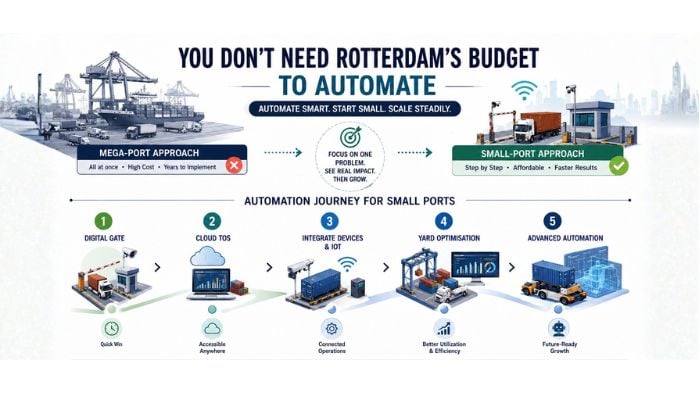
Smaller ports do not need to automate everything at once. Many are starting with one gate, one system and solving one problem at a time. When we talk about port automation, we usually think of big ports like Rotterdam, Singapore, Busan and Shanghai. These ports use automated cranes, autonomous trucks and digital systems across their terminals.
But automation can be very expensive. Long Beach Container Terminal spent about $1.4 billion to automate a terminal with a capacity of 3.3 million TEU. The Port of Santos put the cost of its automated equipment at about $534 million over 35 years.
Complete automation usually makes financial sense for ports handling at least 1 million TEU a year.
Even then, U.S. operators told the Government Accountability Office that it can take 10 to 20 years to recover the cost of automated cargo-handling equipment. McKinsey says a fully automated new terminal needs to cut operating costs by 25% or increase productivity by 30% to make the investment worthwhile.
For smaller terminals handling only a few hundred thousand TEU a year, these costs can make automation seem out of reach. But smaller ports do not need to automate everything.
The Industry Has A Scaling Problem
UNCTAD says ports are at very different stages of digitalisation. At many smaller ports, important information is still handled manually or outside digital systems. It also says that many small and medium-sized ports do not have the skills or staff needed to manage large digital projects on their own. Instead, UNCTAD suggests using simpler technologies that solve specific problems. It also suggests that ports can share the cost of developing these systems.
So, smaller ports do not need to ask, “How can we automate the whole terminal?” A better question is, “Which part of our operation takes the most time, costs the most money or causes the most problems?” They can then start by fixing that one area.
Automation Is a Spectrum, and the Middle Is Crowded
Automation does not always mean using automated cranes across the whole terminal. For smaller ports, semi-automation can be easier and cheaper to introduce. It can cost about $25 million to $45 million, compared with $65 million to $95 million for full automation. It can also take 18 to 24 months to set up, compared with 36 to 48 months for a full system.
Semi-automation can still reduce labour costs by 18% to 25% and increase throughput by 15% to 22%. For terminals handling 1 million to 3 million TEU, it can be a practical alternative to full automation.
What Smaller Terminals Are Actually Doing
Smaller terminals are mainly taking three approaches.
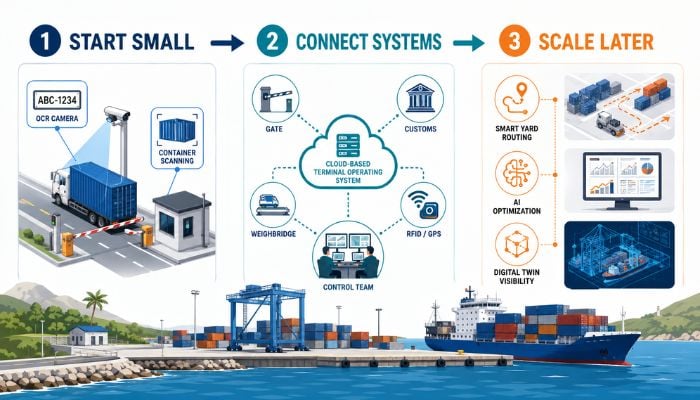
Start with one part of the operation.
Smaller terminals do not need to automate the whole yard. They can start with one process that uses a lot of labour or causes delays. The gate is often a good place to start.
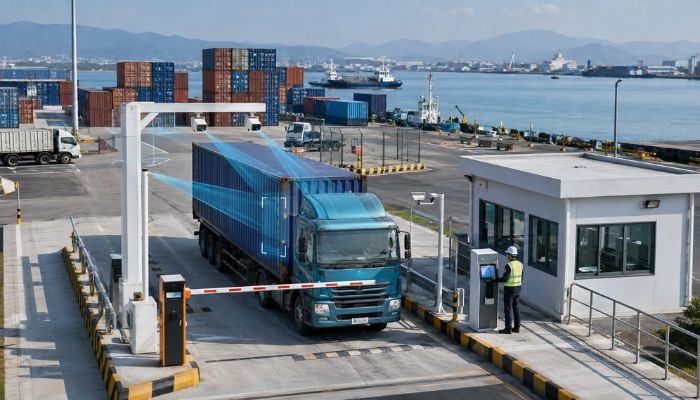
OCR cameras can read licence plates and ISO 6346 container numbers. Along with driver verification, they can process more than 60 trucks per hour per lane with very little need for gate clerks.
The system can reduce gate processing from minutes to seconds. It can also send each movement directly to the terminal operating system, or TOS.
Grendi’s Marina di Carrara terminal in Italy introduced this type of system in 2026. Cameras and sensors read vehicle plates, container numbers and driver details and record each movement digitally.
This is also easier now because some TOS providers allow terminals to buy individual modules instead of a complete system.
For example, Infyz’s iTOMS allows a terminal to start with the gate or invoicing module. It does not have to pay for commercial, marine and planning functions that it may not need yet.
Using cloud-based systems
For a terminal with a small IT team, not having to maintain its own servers can save money and time.
Cloud-based TOS platforms can reduce upfront costs by about 60% compared with older systems that are installed on the terminal’s own servers.
Several companies now offer cloud systems for smaller terminals. Navis Octopi is a cloud-based TOS for terminals handling around 100,000 TEU a year. It reportedly helped Caribbean Port Services in Port-au-Prince increase productivity by 50%.
CyberLogitec’s OPUS Terminal M runs through a browser and can work across different operating systems.
omoqo’s TOM platform went live at Cargo-Terminal Lehmann at the Port of Lübeck in eight weeks with little disruption.
TCS DynaPORT is a cloud-ready TOS used at more than 70 terminals worldwide.
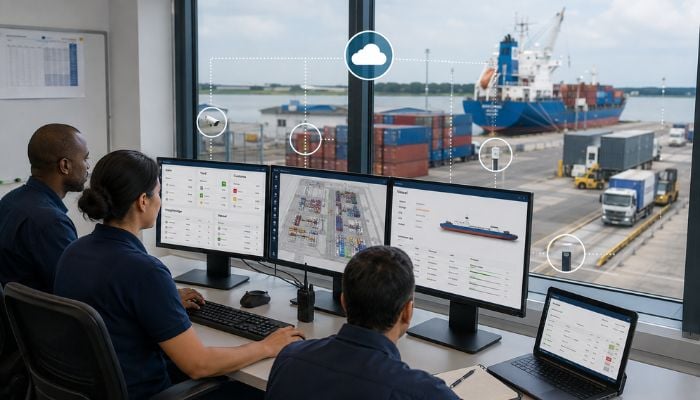
Infyz’s iTOMS is also web-based. It can run on AWS or Azure without being installed locally. Standard configurations are reportedly ready in two to three weeks.
In New York, Red Hook Container Terminal used a cloud TOS to replace spreadsheets and paper records. Its COO said the system helped a small team run the operation.
Introduce Automation in Stages
Smaller terminals can also avoid making one big investment. They can introduce automation one step at a time.
This keeps the initial cost lower and gives staff time to learn the new system. After each stage, the terminal can see if the investment is working before moving to the next one.
There is no fixed TEU number at which selective automation makes sense. A terminal handling 150,000 to 200,000 TEU a year could still benefit from selective automation if labour costs are high or the site has other problems. A larger terminal with cheap land and low labour costs may have less reason to automate. The EU’s CONNECT2SMALLPORTS initiative follows a similar approach across the Baltic region. Small ports are introducing TOS, IoT, cloud and AI systems in stages.
The Port of Koper has also followed a similar approach at the port-community level. Some smaller ports start with something even more basic: connectivity.
The Port of Tyne in the UK built a private 4G/5G network across its site before adding specific applications. These include number-plate recognition at the gate, AI-based container inspection and smart surveillance.
The port is now testing an autonomous terminal tractor through its P-CAL project. In this case, the network came first. The automation came later.
Why Modular Fits Small Ports Better Than Mega-Ports
This step-by-step approach can work better for smaller regional terminals. A large terminal handling huge volumes may need a complete automated system to make the investment worthwhile. That is why some major automation projects cost billions.
A smaller terminal can take a different approach. It can find its biggest problem, automate that part, see how much it helps and then decide what to do next. The rest of the terminal can continue to operate as usual. This can be a useful option for smaller operators.
Cloud-based TOS systems can also help. Infyz’s iTOMS, for example, can run in the cloud or on-premises. It can connect with ERP systems, customs, OCR, weighbridges, RFID and GPS. Its administrative tools also let terminals manage their own data and settings without asking the vendor to make every change. This can be helpful for terminals with small IT teams.
More advanced tools, such as AI-based yard optimisation and digital-twin-style visualisation, can be added later. They do not have to be part of the first investment. That is the main benefit for smaller terminals. They can add technology when they need it instead of buying one large system from the start.
Conclusion
When we talk about port automation, we often look at ports like Rotterdam, Busan and Singapore. But these are examples of large, fully automated terminals that can require billions of dollars. That is not the only way to automate a port. It may not be the right option for most smaller terminals either.
Smaller operators can start with the part of the operation that needs the most improvement. They can use cloud-based systems and add more functions later. Some systems can be introduced in weeks instead of years. You do not need Rotterdam’s budget to make a terminal smarter.
You might also like to read-
Read on the original site
Open the publisher's page for the full experience