Indian Navy Launches Advanced Ocean Research Vessel ‘ORV Sagar Manthan’
Our take
The launch of the ORV Sagar Manthan by the Indian Navy marks a significant advancement in oceanographic research capabilities within the region and underscores a growing global trend towards enhanced maritime scientific exploration. This state-of-the-art vessel joins a fleet increasingly equipped to address complex challenges related to climate change, resource management, and maritime security. The increased focus on ocean research is particularly pertinent given the recent work examining Estimating adult-stage abiotic suitability and climate-driven distributional shifts for the threatened queen conch (Aliger gigas) in the Caribbean, highlighting the vulnerability of marine ecosystems and the need for robust data collection to inform conservation strategies. Further contextualizing this development, the Indian Navy’s broader modernization efforts, including the acquisition of new loitering munitions Indian Navy To Acquire New Type Of Loitering Munition With A 1000 Km Range, demonstrate a commitment to technological advancement across multiple domains, with oceanographic research clearly identified as a key component of their strategic vision.
The Sagar Manthan's advanced instrumentation and design will facilitate a broader range of research activities, from deep-sea exploration and geological surveys to atmospheric monitoring and biological assessments. The vessel’s capabilities should allow for the collection of high-resolution data, contributing to a more comprehensive understanding of the Indian Ocean’s dynamic processes. This is crucial given the ocean’s role in regulating global climate patterns and supporting vital marine resources. The ability to conduct longitudinal studies, tracking changes in ocean conditions over extended periods, will be particularly valuable for assessing the impacts of climate change and informing adaptive management strategies. The vessel’s deployment aligns with the global imperative for integrated data ecosystems, where observations from diverse platforms – satellites, autonomous vehicles, and research vessels – are combined to generate ocean intelligence. The research conducted aboard the Sagar Manthan is expected to contribute significantly to this growing body of knowledge, furthering our understanding of complex oceanographic phenomena.
The implications of this development extend beyond the immediate scientific community. Increased oceanographic data availability will benefit policymakers, resource managers, and industries reliant on ocean resources, such as fisheries and shipping. Accurate and validated data are essential for developing effective policies to mitigate the impacts of climate change, protect marine biodiversity, and ensure the sustainable use of ocean resources. Furthermore, the collaborative nature of ocean research, exemplified by the exploration of the Crozet Basin and Plateau From Terra Incognita to ocean sanctuary: a review of scientific insights into the marine diversity of the Crozet Basin and Crozet Plateau, is crucial for addressing transboundary challenges. The Sagar Manthan, as a platform for scientific collaboration, can foster partnerships between Indian researchers and international colleagues, promoting the sharing of knowledge and expertise.
Looking ahead, the effectiveness of the Sagar Manthan will depend not only on its technological capabilities but also on the development of robust data management and analysis protocols. The ability to integrate the vessel’s data with existing datasets and to translate scientific findings into actionable insights will be critical for maximizing its impact. A key question to watch will be how the Indian Navy leverages the vessel’s capabilities to contribute to global ocean observing systems and to participate in international collaborative research initiatives. The long-term sustainability of oceanographic research efforts, including the Sagar Manthan program, will require continued investment in infrastructure, personnel, and data infrastructure—a commitment vital for ensuring continued progress in understanding and protecting our oceans.
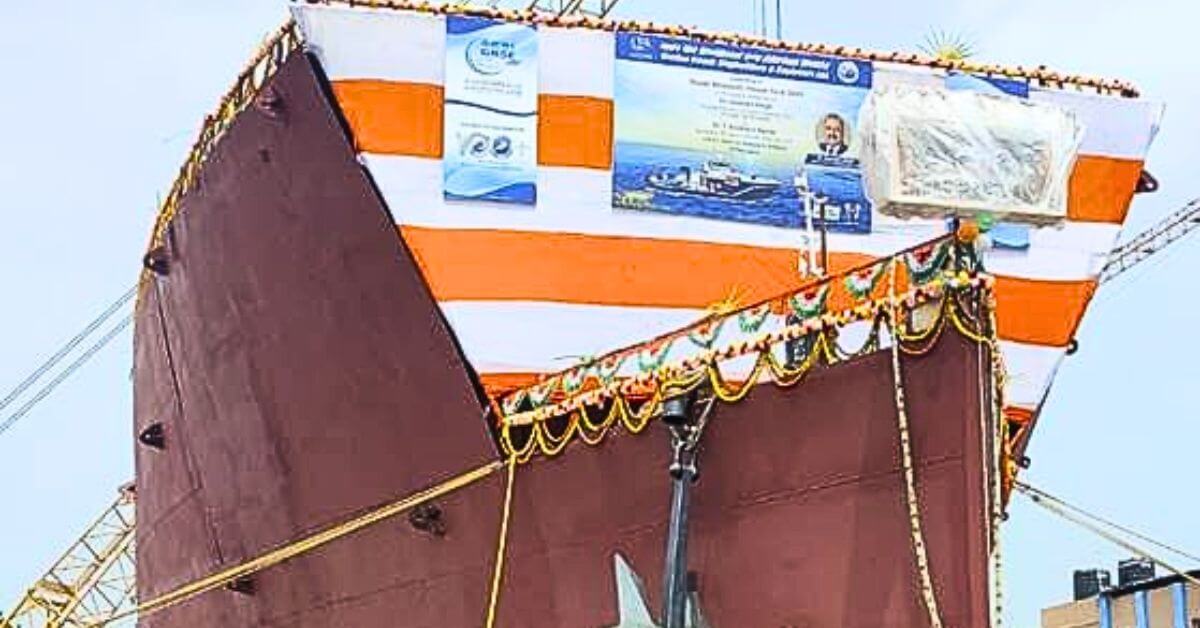
Marking a historic milestone in India’s journey toward self-reliance in oceanographic science and maritime technology, the state-of-the-art Ocean Research Vessel (Yard 3041), officially named ORV Sagar Manthan, was launched at the Rishi Bankim Shipyard, Kolkata.
Designed, engineered, and constructed by defense public sector undertaking Garden Reach Shipbuilders & Engineers Limited (GRSE) for the National Centre for Polar and Ocean Research (NCPOR), under the Ministry of Earth Sciences (MoES), the vessel was officially launched through virtual presence by Dr. Jitendra Singh, Hon’ble Minister of Earth Sciences, Government of India, with his spouse Mrs Manju Singh, who named the vessel, keeping with the tradition. The event was held in the august presence of Dr T. Srinivasa Kumar, Secretary, Ministry of Earth Sciences, Government of India, who was joined by his spouse, Mrs Kavita Ellanti, for the ship launch in Kolkata.
Hon’ble Minister highlighted National Pride, Global Ocean Geopolitics, and Atmanirbharta. Delivering the keynote address (virtual), Dr Jitendra Singh, Hon’ble Minister of Earth Sciences, termed the occasion a “red letter day” for NCPOR, the Ministry, and the nation. He praised the team for achieving the launch within just two years of contract signing and barely five months after keel laying, hailing it as an exceptional display of efficiency.
Highlighting the strategic and scientific necessity of the vessel, Dr Jitendra Singh (through his message) conveyed: “This fine ship is India’s first advanced Ocean Research Vessel built by GRSE, displaying the required thrust towards Atmanirbharta and self-reliance that Hon’ble Prime Minister Shri Narendra Modi Ji has been laying so much stress on. Knowledge is strength, and this knowledge can only be gained through research. Today, the world knows very little about our oceans, yet they provide vital inputs about melting polar glaciers, maritime impact, and climate dynamics. Solid data collected by vessels like ORV Sagar Manthan will allow India to lead the global path in disaster prevention, take corrective environmental measures, and play a pivotal role in global ocean geopolitics.”
Dr Singh noted that the feature-rich ORV Sagar Manthan will gradually replace the iconic 43-year-old ORV Sagar Kanya (procured from Germany in 1983), commending MoES plans to acquire more oceanographic vessels and a Polar Research Vessel in the near future.
MoES Secretary emphasised Scientific Capabilities and Indigenous Transition
In his address, Dr T. Srinivasa Kumar, Secretary, Ministry of Earth Sciences, expressed pride in India’s policy shift from acquiring research platforms abroad to building them domestically.
Elaborating the core scientific impact, Dr T. Srinivasa Kumar remarked:
“As an oceanographer, I have witnessed first-hand the immense value of ocean research. It is the foundation for understanding climate challenges, predicting tsunamis, and strengthening maritime capabilities. The capabilities of this new ORV excite me as a scientist. It will feature underway swath multibeam surveys, geophysical profiling, atmospheric observations, and water column sampling. GRSE has passed a complex challenge with flying colours, proving that India is among the select few nations capable of designing and constructing such complex platforms.”
Project Background and Strategic Significance
Constructed under Vertical-4 (Deep Ocean Survey and Exploration) of the Government of India’s flagship Deep Ocean Mission (DOM) at an approximate cost of Rs. 840 Crore, ORV Sagar Manthan is an all-weather, multidisciplinary platform. It is engineered to operate in extreme oceanic environments, including the Southern Ocean, with a projected service life of 30 years.
Key Technical & Operational Features
Advanced Equipment: Integrated with dynamic positioning, multibeam bathymetry, multichannel seismic systems, sub-bottom profiling, weather radar, drop keels, and deployment facilities for Remotely Operated Vehicles (ROV) and Autonomous Underwater Vehicles (AUV).
Research Spectrum: Will support multidisciplinary exploration along the Indian Ocean mid-oceanic ridges to identify multi-metal hydrothermal sulphide mineralisation, establish environmental baselines, collect upper-air data, and undertake CTD profiling.
Dual-Class Certification: Built in full compliance with international regulatory standards under dual-class certification by the Indian Register of Shipping (IRS) and the American Bureau of Shipping (ABS).
Project Milestones: Following contract signing in July 2024, first steel cutting on November 29, 2024, and Keel Laying on April 08, 2026, the vessel successfully transitioned from the erection dock to the construction dock today.
Following its launch, superstructure erection, system integration, and extensive sea trials will proceed before its final delivery for commissioning to NCPOR/MoES, which is scheduled for 2028.
The ceremony featured key ceremonial milestones conducted by distinguished dignitaries. After the welcome address by Cmdr PR Hari, C&MD, GRSE, the Launching & Naming Ceremony of Yard 3041 through the official Unveiling of the Name Plaque was done in the presence of Dr MV Ramanamurthy, Mission Director, Deep Ocean Mission and Dr Thamban Meloth, Director, NCPOR, MoES. Marking the flagship moment of the occasion, the formal Launching of the Ship was successfully executed by officially transferring the advanced vessel into the water to begin its next phase of construction.
Read on the original site
Open the publisher's page for the full experience