Indian Navy To Acquire New Type Of Loitering Munition With A 1000 Km Range
Our take

The Indian Navy’s impending acquisition of a new loitering munition with a 1000 km range represents a significant shift in naval warfare capabilities and underscores a broader trend toward increasingly autonomous and long-range strike assets. This development, planned as part of a universal strike system capable of targeting both maritime and land-based objectives, necessitates a reassessment of regional power dynamics and the evolving nature of naval operations. The move is particularly noteworthy given the ongoing modernization efforts within the Indian Navy, including their pursuit of indigenous SATCOM terminals to improve connectivity between warships Indian Navy Seeks Indigenous SATCOM Terminals To Improve Connectivity Between Warships – a critical element for effective deployment of such a long-range weapon – and the potential retirement of older Kilo-class submarines Indian Navy May Retire Up To Three Kilo-Class Submarines Within 5 Years. These interconnected upgrades demonstrate a commitment to a more technologically advanced and strategically flexible naval force.
The capability offered by these loitering munitions – often referred to as "suicide drones" – is substantial. The extended range allows for engagement of targets far beyond the immediate operational area of naval vessels, effectively expanding the Navy’s reach and complicating adversary defensive planning. This is especially relevant in the context of the Indian Ocean region, characterized by complex geopolitical considerations and potential flashpoints. The dual-target capability – sea and land – further enhances the system’s versatility, enabling responses to a wider range of threats and scenarios. While details regarding the specific platform and sensor suite remain limited, the announced range suggests a sophisticated design incorporating advanced navigation and targeting systems. The commissioning of the INS Nipun, an indigenously built diving support vessel Watch: Indian Navy Commissions Indigenously Built Diving Support Vessel ‘INS Nipun’, also contributes to this trend of bolstering indigenous naval capabilities, and may indicate a future synergy between manned and unmanned assets.
The integration of loitering munitions into the Indian Navy's arsenal reflects a global trend towards precision strike capabilities and a reduced reliance on traditional, high-cost platforms. This shift is driven by both economic factors and the increasing sophistication of air defense systems, which make manned strike aircraft more vulnerable. The ability to loiter over a target area, analyze the situation, and then strike with precision offers a significant advantage in complex operational environments. From a strategic perspective, this acquisition enhances India’s ability to project power and respond to evolving security challenges in the region. The “universal strike system” concept also points towards a move towards modular and interoperable weapon systems, allowing for greater flexibility and adaptability in future conflicts. The validated range and precision of such a system will require careful calibration and empirical testing to ensure operational effectiveness and minimize collateral damage, underscoring the need for robust training and data integration.
Looking ahead, the deployment and operationalization of this new loitering munition will be a key indicator of the Indian Navy's evolving doctrine and its ability to integrate advanced technologies into its overall strategy. The effectiveness of this system will depend not only on its technical capabilities but also on the development of appropriate command and control structures, data analytics capabilities, and the integration of ocean intelligence to enhance target identification and engagement. A crucial question to watch will be how the Indian Navy balances the benefits of increased range and precision with the ethical considerations and potential risks associated with autonomous weapon systems, particularly in densely populated coastal regions.
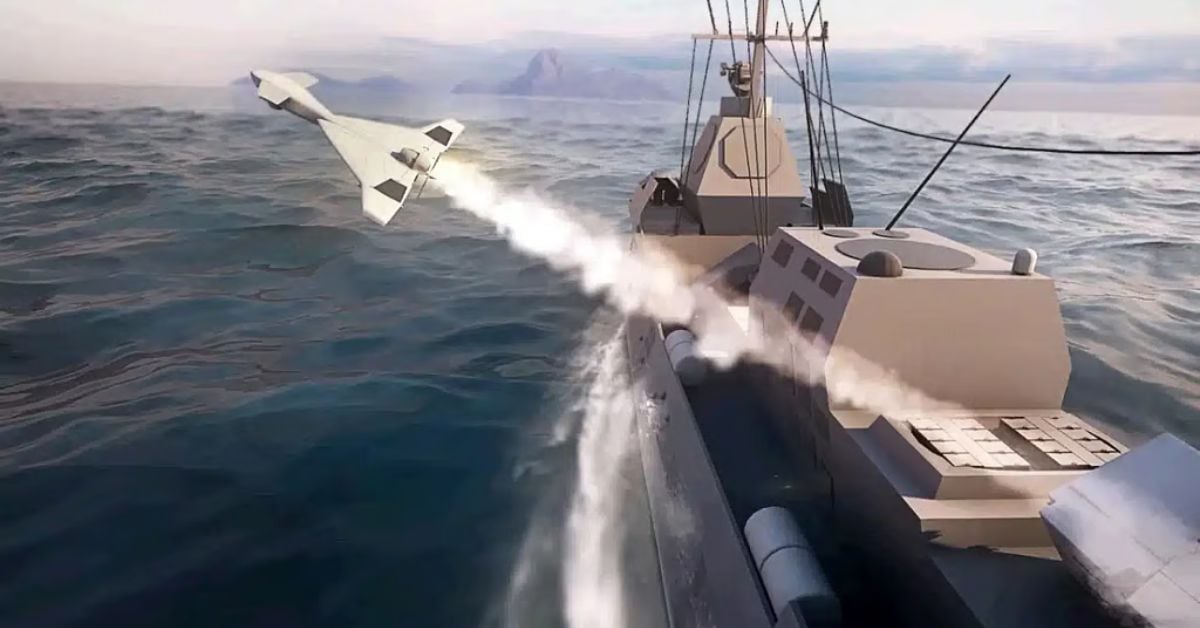
The Indian Navy has issued a Request for Information (RFI) for a new medium-range loitering munition that can be launched from naval ships or shore-based vehicles.
The weapon is planned as a universal strike system that can be used against both sea and land targets.
The Navy wants the munition to have a range of over 1,000 kilometres and stay in the air for more than nine hours at speeds above 75 knots. It must also be able to fly up to 15,000 feet, or about 4,600 metres.
India already operates a locally made version of the Harop loitering munition, which was originally designed by Israel Aerospace Industries (IAI).
However, India does not currently have an operational land- or sea-based loitering munition with a range of 1,000 kilometres.
What the Navy wants?
The munition must not be more than 2.5 metres long and must have a wingspan of up to three metres.
The Navy wants it to have a modular design and a stabilised electro-optical/infrared (EO/IR) seeker. This will be used for intelligence, surveillance and reconnaissance, as well as target acquisition and final guidance to the target.
The munition will be launched from a canister and must use radio-frequency and satellite datalinks.
The mission control system must be able to handle up to 10 munitions at the same time. Control must also be transferable between ship-based and land-based control stations.
The munition must be able to operate on its own when GNSS signals are unavailable or denied.
The proposed munition is similar in size, range and endurance to the Iranian Shahed-136, which is powered by a piston engine.
India wants the system made locally
The RFI allows the Navy to buy the system under either the Buy (Indian-IDDM) or Buy (Indian) categories.
Under Buy (Indian-IDDM), the munition must be designed and built in India. Under Buy (Indian), Indian companies can work with foreign equipment manufacturers through technology transfer or joint ventures.
The Navy therefore wants the munition to either be designed and made in India or produced by Indian companies working with foreign OEMs.
Several Indian companies are already working on long-range loitering munition systems that could potentially be adapted for naval use.
The Sheshnaag 150, being developed by NewSpace Research & Technologies, has already been flight-tested.
CSIR-NAL and Solar Industries are working on another system that uses an indigenous NAL Wankel engine.
India already uses the Harop
The Indian military currently uses a locally made version of the Harop loitering munition, which was designed by IAI.
The locally produced version is identified as the Agnikaa, manufactured by Adani Defence. India also used the Harop-derived system during Operation Sindoor in 2025.
The existing system does not give India an operational sea or land based loitering munition with a 1,000-kilometre range.
The new Navy requirement is for a longer-range system that can be launched from ships as well as shore-based vehicles and used against both maritime and land targets.
References: bairdmaritime, navalnews
Read on the original site
Open the publisher's page for the full experience