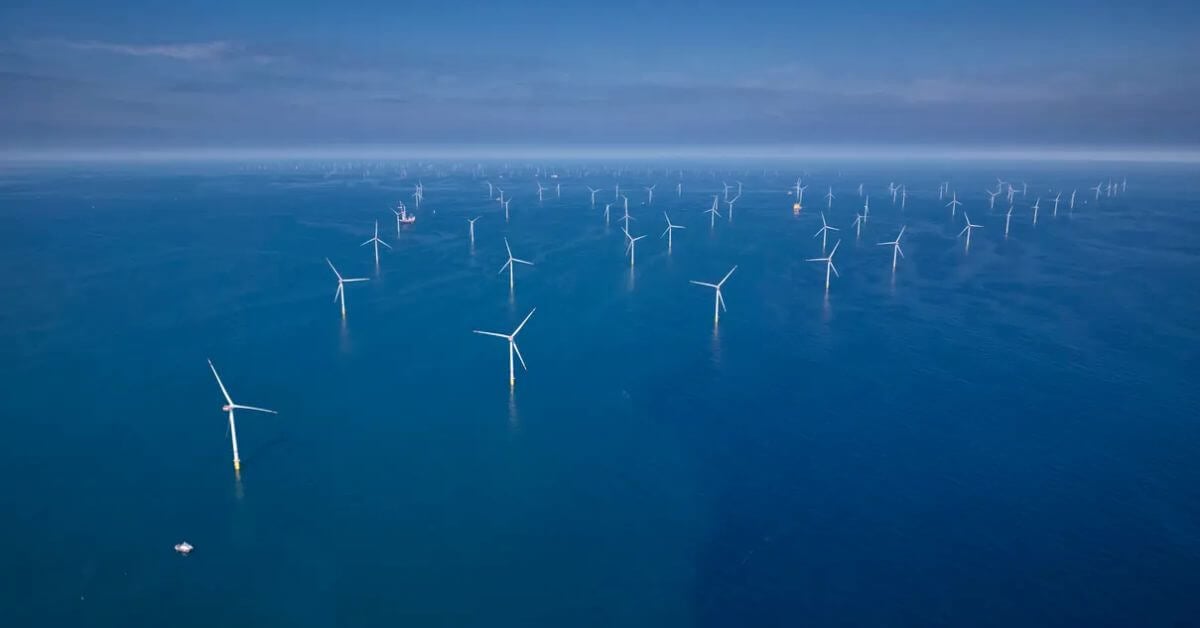
He Dreiht Wind Farm Powers German Grid, Boosting Renewable Capacity
Germany’s renewable energy capacity has significantly increased with the inauguration of the 960-megawatt He Dreiht offshore wind farm in the North Sea.
·6 min read·Marine Insight
Image Credits: enbw
Germany has inaugurated the 960-megawatt (MW) He Dreiht offshore wind farm in the North Sea. The first turbines are already sending electricity to the German grid.
The wind farm is about 85 kilometres northwest of Borkum and has 64 Vestas V236-15.0 MW turbines. With 960 MW of installed capacity, it is Germany’s largest offshore wind farm.
EnBW, Allianz, AIP Management and Norges Bank Investment Management inaugurated the project in the presence of German Federal Environment Minister Carsten Schneider.
He Dreiht was built without state funding. Its electricity is being sold through long-term power purchase agreements (PPAs). About €2.4 billion is being invested in the project.
EnBW owns 50.1% of He Dreiht through a project company. A consortium made up of Allianz Global Investors, AIP Management and Norges Bank Investment Management owns the remaining 49.9%.
EnBW won the project in 2017 in Germany’s first offshore wind auction. The project was awarded without state funding.
Construction started in May 2024 with the installation of the foundations.
The first turbine was installed in April 2025. It was the first offshore installation of the Vestas V236-15.0 MW turbine. All 64 turbines were installed by August.
The foundations were made in Germany. Each one uses steel pipes that are nine metres wide and 70 metres long.
Other parts of the project came from several European countries. The connecting parts between the foundations and towers were made in Belgium, Britain, the Netherlands and Poland.
The components were taken to the construction site from the ports of Esbjerg in Denmark and Eemshaven in the Netherlands.
More than 500 people worked at the site during the busiest periods. More than 60 vessels were also involved in the construction work. EnBW managed the offshore work from its office in Hamburg.
Several companies have signed long-term PPAs for electricity from He Dreiht.
They include Evonik, Google, PASM, Fraport, Bosch, Salzgitter, SHS Stahl-Holding Saar, Deutsche Bahn and DHL Group.
The agreements give the companies longer-term price stability and help them plan their electricity use. They can also use the agreements to support their climate targets.
EnBW said PPAs will remain important as electricity demand grows because of digitalisation and artificial intelligence applications.
The wind farm can produce enough electricity to meet the yearly needs of about 1.1 million households, according to EnBW.
TenneT is responsible for connecting He Dreiht to the German electricity grid.
Electricity from the wind farm travels to the coast through an offshore platform and two submarine cables.
He Dreiht is being brought online step by step. Each turbine has to be connected to the grid, tested and then started.
Some turbines are already producing electricity. The remaining turbines will be connected as commissioning continues.
EnBW expects the entire wind farm to be operating in the coming months.
Each turbine has a capacity of 15 MW. The turbines have a hub height of 142 metres and a rotor diameter of 236 metres.
The rotor covers an area of about 44,000 square metres as it turns. EnBW says this is roughly the size of six football fields.
The company also says one turn of the rotor can produce enough electricity to meet the equivalent of four households’ needs for one day.
EnBW is also working on two more offshore wind projects. Dreekant has a planned capacity of 1 GW in the German North Sea, while Morven has a planned capacity of 2.9 GW in Scotland.