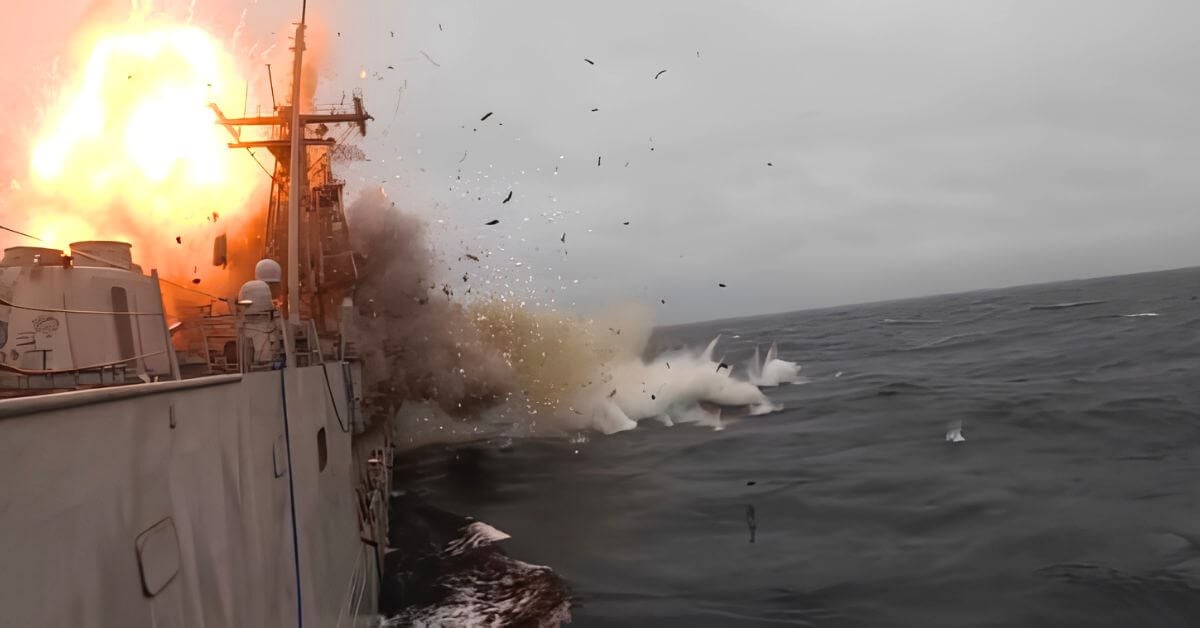
The U.S. Navy and UK forces have sunk a decommissioned American frigate off the coast of Scotland during a joint missile exercise. On its surface, this is a routine end-of-life disposal for a warship, but the location and the collaboration carry a weight that deserves closer scrutiny. This is not simply target practice; it is a calibrated demonstration of interoperability between allied naval forces in a strategic maritime corridor. The act itself is measurable, a vessel validated as a target, then engaged, but what it signals about shared operational readiness is far more significant. This event unfolds alongside other indicators of naval evolution, such as China’s New Nuclear Carrier Signals Extended Naval Operations Capability and the U.S. Navy Accelerates Submarine Production with Integrated Strategy, both of which point to a global recalibration of maritime power.
For our readers, whether researchers tracking climate indicators, policymakers assessing defense budgets, or ocean enthusiasts monitoring seafloor impacts, this exercise raises practical questions about the ocean as a shared domain. A decommissioned frigate sunk in the North Atlantic is a deliberate placement of material in an integrated data ecosystem. The wreck becomes an artificial reef, but also a potential source of contaminants if not properly prepared. The U.S. Navy has protocols for environmental mitigation, but the empirical data on long-term effects from such sinkings remains longitudinal in nature, requiring years of peer-reviewed study. We would tell a reader who asks: do not mistake the surface-level event for the full story. The real data lies in how these exercises calibrate future naval strategy and what they reveal about the priorities of allied forces.
This exercise also contrasts sharply with the autonomous capabilities highlighted in Autonomous Vessel Demonstrates Advanced Torpedo Deployment Capability. Here, a manned warship was sunk by manned platforms, a traditional, kinetic demonstration. The autonomous test, by contrast, suggests a future where precision and distance replace brute force. The contrast is instructive: while the frigate sinking validates current doctrine, the uncrewed torpedo test hints at a measurable shift in how naval power will be projected. One is a conclusion; the other is a beginning.
Our take is direct: this sinking is not an anomaly, but a data point in a larger pattern of ocean intelligence. The specific consequence to watch is how allied navies integrate these sinkings into their training feedback loops, and whether the environmental impact assessments are made public and peer-reviewed. The takeaway a reader could quote? "A warship sunk in joint exercise is a calibrated signal of readiness, not an isolated event, it belongs to a broader, empirical picture of how nations are preparing to operate in a changing ocean." The question we are left with is whether the data from these exercises will be shared openly, or remain classified under the same waters that now hold the frigate.