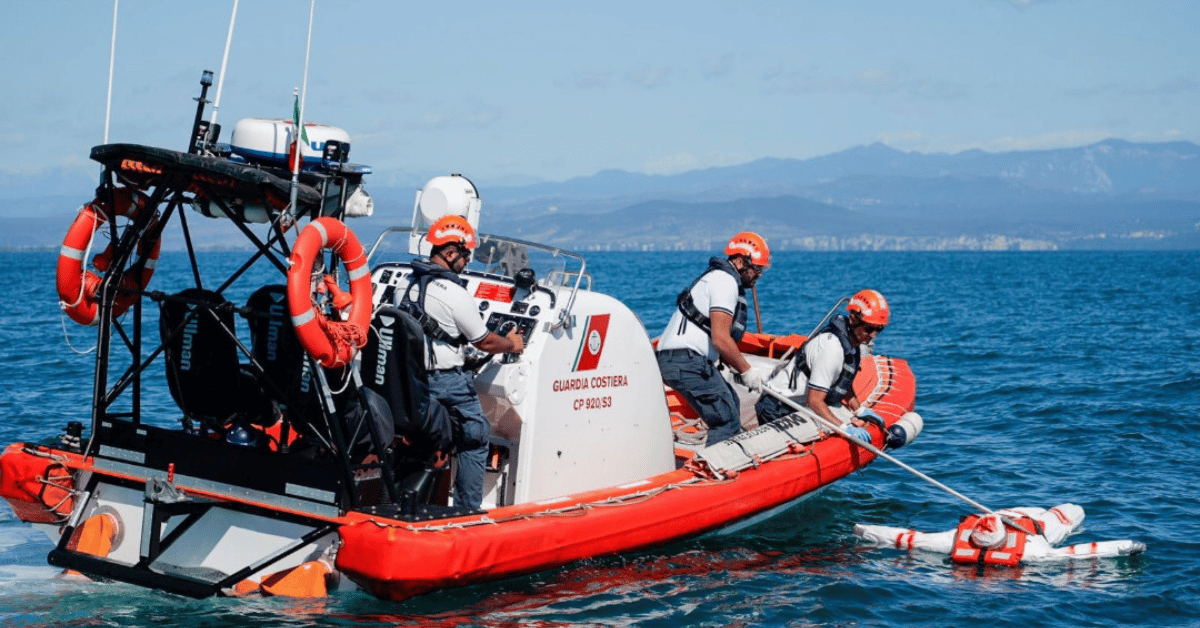
The Gulf of Trieste is a narrow, shared body of water, and last week it became a laboratory for something far more consequential than a routine safety drill. Italy, Croatia, and Slovenia conducted a joint search-and-rescue exercise there, simulating a fishing vessel collision to test their cross-border coordination. The exercise itself is not news, nations run drills every season, but the fact that the parties chose to validate integrated SAR protocols in a real-time, cross-border context is worth our attention. This is not a symbolic gesture. It is an empirical test of how quickly data, command, and resources can move across sovereign lines when lives depend on it.
This matters because the Mediterranean is not getting calmer. Russian Maritime Activity Raises Concerns of Drone Operations in Mediterranean has introduced a new layer of operational complexity for navies and coast guards, while Unexplained Acoustic Event Detected in Southern Italian Waters reminds us that we still lack calibrated, peer-reviewed baselines for what is normal in these waters. A fishing vessel collision is a straightforward emergency compared to a suspected drone launch or an unidentified acoustic anomaly. If three nations cannot synchronize their SAR protocols for a scenario as predictable as a collision, they have no hope of responding to the ambiguous, fast-evolving threats that are already emerging. The Gulf of Trieste drill is a useful stress test, but it raises an open question: were these integrated protocols designed to scale, or are they a one-off for a single basin?
What we would tell a reader who asks about this is simple: watch the after-action report. The value of this exercise is not in the press release but in the measurable, longitudinal data it generates, response times, communication lag, resource allocation across borders. If the three countries publish validated metrics, other regions in the Mediterranean can calibrate their own protocols against them. If they do not, the exercise remains an isolated event with limited utility. The most concrete takeaway here is that ocean intelligence depends on interoperability. Satellites, buoys, and patrol vessels generate streams of data, but that data is useless if national command centers cannot integrate it in real time during a crisis. The Gulf of Trieste drill is a small, practical step toward that integration. The next step is to ensure the findings are shared, peer-reviewed, and applied to the more complex scenarios already visible on the horizon, such as the expanded naval presence being calibrated for Red Sea shipping security. Coordination that works in a controlled drill must prove itself under real pressure. That proof has not yet arrived.