Real Life Incident: Tug Name Mix-Up Causes Tanker To Strike Pier During Departure
Our take
The recent incident involving a tanker striking a pier due to a tug-name mix-up underscores a critical vulnerability within maritime operations – the potential for human error, even in seemingly routine procedures. While technological advancements continue to reshape the industry, the fundamental reliance on clear communication and meticulous verification remains paramount. This event, occurring during a night departure with two tugs assisting, highlights the complexities of coordinated maneuvers and the cascading impact of a single miscommunication. The incident echoes similar challenges previously observed, such as the collision of bulk carriers in dense fog where an untracked vessel went unnoticed Real Life Incident: Vessels Collide In Dense Fog During Sudden TSS Turn, illustrating a recurring theme of situational awareness and procedural adherence. It also draws a parallel to the exploration of marine environments, as seen in observations of creatures like decorator crabs Spotted in Friday Harbor, WA. Is this a decorator crab?, where even seemingly minor details can have significant consequences for survival and navigation.
The significance of this incident extends beyond the immediate damage and disruption. It serves as a potent reminder that layered safety protocols are not merely bureaucratic requirements, but essential safeguards against preventable accidents. The reliance on verbal communication, even with established protocols, is inherently susceptible to ambiguity and misinterpretation, particularly in the dynamic and often stressful environment of a ship's departure. The incident begs the question: are current communication practices sufficiently robust to mitigate the risk of such errors? The industry is increasingly adopting digital communication tools and automated systems, but the human element remains a critical interface. Integrated data ecosystems, providing real-time, validated information to all involved parties, could significantly reduce the likelihood of these errors by removing ambiguity and providing a single source of truth. Calibration of communication protocols across all teams—bridge officers, tug operators, and shore-side personnel—is crucial for maintaining a shared understanding of intentions and actions.
Furthermore, the incident’s occurrence during nighttime operations points to the increased challenges presented by reduced visibility. While navigation technology has advanced considerably, human perception and judgment remain vulnerable to the limitations of low-light conditions. Longitudinal data analysis of similar incidents, coupled with empirical studies of human performance under stress, are vital for developing targeted training programs and refining operational procedures. This is not simply about blaming individuals; it is about identifying systemic weaknesses in the processes that govern maritime operations. Peer-reviewed research into the cognitive factors contributing to errors in high-pressure situations is necessary to inform best practices and enhance crew resilience. The ocean intelligence gleaned from such analyses can lead to the development of more effective safety measures and ultimately, a reduction in maritime incidents.
Looking ahead, the imperative is to move beyond reactive responses to proactive risk mitigation. The increasing complexity of global shipping routes and the growing volume of maritime traffic demand a shift towards predictive safety measures. Real-time data streams, integrated with advanced analytics, can provide early warnings of potential hazards and allow for preemptive adjustments to vessel trajectories and operational plans. The incident underscores the need for a continuous assessment of human-machine interfaces and the development of technologies that augment, rather than replace, human expertise. A critical question moving forward is: how can we leverage the power of integrated data ecosystems and climate indicators to build a more resilient and safer maritime environment, ensuring that preventable errors like this become a rarity, not a recurring event?
A tanker was preparing for departure at night, with light winds and two tugs alongside to help leave the berth. The Master and pilot had exchanged information on the manoeuvre, including the placement and use of the tugs.
The plan was to use two tugs: one with a line forward near the bow and one with a line aft. The pilot expected the current to be running at about 1.9 knots from stern to bow. Given this, the plan was to have both tugs pull the vessel off the pier together, but with the aft tug pulling faster than the forward tug to open up the stern and have the current help push them off. Once the tugs had pulled the tanker far enough off the pier to allow a safe departure, the tugs would be released.
In his notebook and on the mooring plan diagram of the Master/pilot exchange form, the pilot wrote down the placement and names of each of the two tugs. As was his practice, he also wrote down the names and placement of each tug on a ‘radio card ’ (reference card), which he would have with him on the bridge wing for quick reference. Tug DD was at the bow, with tug DC at the stern. It was discovered in the subsequent investigation that he had transposed the names of the two tugs on the radio card.
At 0400, the pilot directed both tugs to push on the starboard side of the ship to hold it against the pier while the mooring lines were let go forward and aft. When all mooring lines were on deck, the pilot, using the tugs’ names, ordered tug DD to pull dead slow away, followed by half away, and then ‘three-quarters away’ (meaning pull at 75% power away from the pier). He ordered tug DC to pull ‘minimum away’ (meaning to pull at minimum power away from the pier). About the same time, in anticipation of the ebb current, the pilot ordered the tanker’s main propulsion to dead slow astern.
As the vessel came off the berth, the pilot ordered tug DC to stop. Seconds later, the pilot radioed DD and asked the operator to be on a 90° angle to the tanker with the tug line. The operator responded that he was ‘pretty darn close’. The pilot replied, ‘You are at a 45 [degree angle] and you should be forward of the line’. Seconds afterwards, the Master announced to the pilot that the ‘aft is too close’.
The pilot ordered the main propulsion of the vessel stopped. The pilot then ordered tug DD to pull ‘full away’ and ordered the rudder hard to port. Seconds later the vessel contacted the northeastern corner of the pier. The pilot asked the Master if the rudder was hard to port, which the Master confirmed. The pilot then ordered the tanker’s propulsion to dead slow ahead and asked tug DC if they were stopped. The tug operator confirmed he was. The Master asked the pilot, ‘What is going on?’
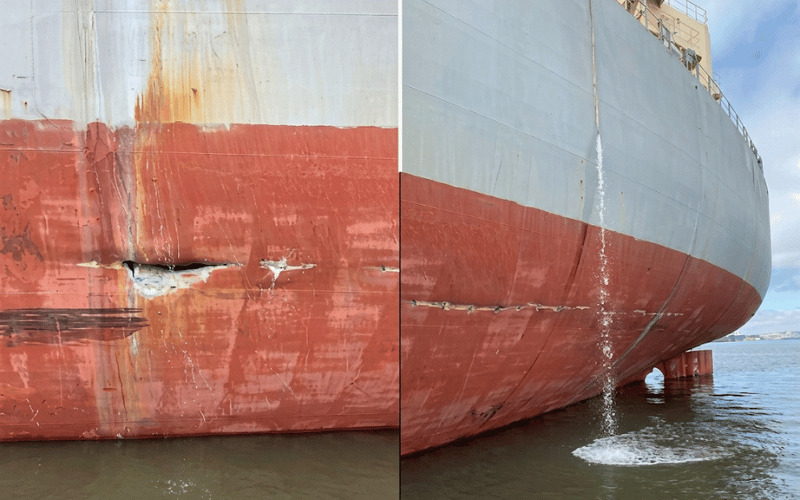
At this point, the pilot thought there had to be a miscommunication with the tugboats, but as the vessel was now coming away from the berth, the tugs were released. Damage to the port side of the vessel was important while the berth was also somewhat damaged.
The official investigation found, among other things, that the pilot had transposed the names of the tugs on his ‘radio card’. As such, orders intended for the tug aft were given to the tug on the bow and vice versa. The result was the bow being rapidly pulled away from the pier, causing the stern of the ship to move toward the pier in a 1.9-knot quartering current. This was contrary to the plan to pull the vessel’s stern off the pier quicker than the bow.
Lessons learned
- Every member of the bridge team should have the same mental model of the manoeuvre so that an inconsistency can be detected early enough to avoid negative consequences. While the manoeuvre was understood by all, the vessel’s officers did not detect the pilot’s error in tug orders. This may have been due to the use of tug names as opposed to tug position (fore and aft) or number (tug 1, tug 2, usually from forward).
- Using tug names for vessel manoeuvres introduces a weak link in a multi-person operation. Everyone on the assisted vessel’s bridge must remember which tug, by its name, is where to have a correct mental model of the developing situation.
Read on the original site
Open the publisher's page for the full experience