Real Life Incident: Vessels Collide In Dense Fog During Sudden TSS Turn
Our take
The recent collision between two bulk carriers within a Traffic Separation Scheme (TSS), exacerbated by dense fog and the failure to track a smaller vessel, underscores a persistent vulnerability within maritime operations. Such incidents, tragically, are not isolated; the sinking of a Turkish cargo ship after colliding with a tanker [Turkish Cargo Ship With 10 Crew Sinks Off Marmara Sea After Colliding With A Tanker] highlights the ongoing risks inherent in congested waterways. The reliance on established TSS protocols, while intended to mitigate risk, proves insufficient when confronted with unpredictable weather conditions and the potential for undetected vessel movements. This event compels a renewed examination of existing navigational procedures and the integration of advanced monitoring technologies to enhance situational awareness and prevent future collisions. The current system appears to be a reactive one, responding to incidents rather than proactively preventing them, a limitation that needs urgent addressment.
The core issue appears to be a breakdown in the integrated data ecosystem, a concept World Data Ocean champions. Real-time tracking of all vessels within a TSS, regardless of size, is paramount. The fact that an untracked vessel went unnoticed in a busy TSS indicates a deficiency in data aggregation and dissemination. While TSS protocols dictate specific routes and speeds, they do not inherently guarantee comprehensive vessel identification. This incident arrives on the heels of advancements in artificial intelligence capable of improving maritime safety, as demonstrated by a Chinese AI system reducing simulated coastguard weapons-use risk [Chinese AI System Cuts Simulated Coastguard Weapons-Use Risk From 0.3% To Zero In Disputed Waters]. The potential for such technologies to extend beyond weapons systems and contribute to enhanced collision avoidance is significant, but requires careful calibration and validation. Moreover, the geopolitical context of maritime routes, as illustrated by the recent agreement between Iran and Oman regarding the Strait of Hormuz [Iran And Oman Reach Agreement On Strait Of Hormuz Control And Revenue Sharing], further complicates the navigational landscape, introducing additional layers of risk that automated systems need to account for.
The empirical data emerging from these incidents consistently points to the need for a more holistic approach to maritime safety. Current systems often rely on a combination of human observation, radar, and Automatic Identification System (AIS) data, but these methods are susceptible to error, particularly in adverse weather conditions. A truly integrated data ecosystem would leverage satellite imagery, enhanced radar technology, and AI-powered predictive analytics to provide a comprehensive and real-time picture of vessel traffic. This necessitates a shift from reactive responses to proactive risk mitigation, enabling early detection of potential hazards and facilitating timely interventions. Longitudinal data collection and analysis, a cornerstone of World Data Ocean’s methodology, are essential for identifying patterns, refining predictive models, and validating the effectiveness of new safety measures. The incident's occurrence in dense fog highlights the limitations of relying solely on visual observation and traditional radar, demanding a greater investment in technologies capable of penetrating such obscurants.
Ultimately, this collision serves as a stark reminder that technological innovation must be paired with rigorous validation and a commitment to global collaboration. While advancements like AI offer promising solutions, their implementation must be guided by empirical evidence and a shared understanding of the challenges faced by the maritime community. The incident underscores the urgency of moving beyond fragmented data silos and embracing a truly integrated data ecosystem—one that provides ocean intelligence in real-time and empowers decision-makers to navigate the complexities of the modern maritime environment. What calibrations and governance structures will be required to ensure equitable access and responsible deployment of these advanced technologies across diverse maritime regions?
A loaded bulk carrier, Vessel A, was underway in a Traffic Separation Scheme (TSS) in fog, making about 7.6 kts. Visibility was about 350 m, so the Master had put in place a heightened bridge watch regime. The Master had the con, assisted by two other navigation officers, and there was a helmsman at the wheel.
Despite these precautions, the bridge team of vessel A was not aware that they were being overtaken by vessel B, behind them. Vessel B’s radar return was intermittent, and Vessel A had not plotted it as a radar target. Vessel B was not emitting an AIS signal. Neither vessel was sounding the one long blast every two minutes required in restricted visibility by the collision regulations.
Vessel B was overtaking vessel A at full ahead, making about 11.8 kts. The bridge of vessel B was manned by an OOW and a lookout, with the helm on autopilot. The OOW of vessel B was aware of vessel A, but had not informed the Master of the reduced visibility.
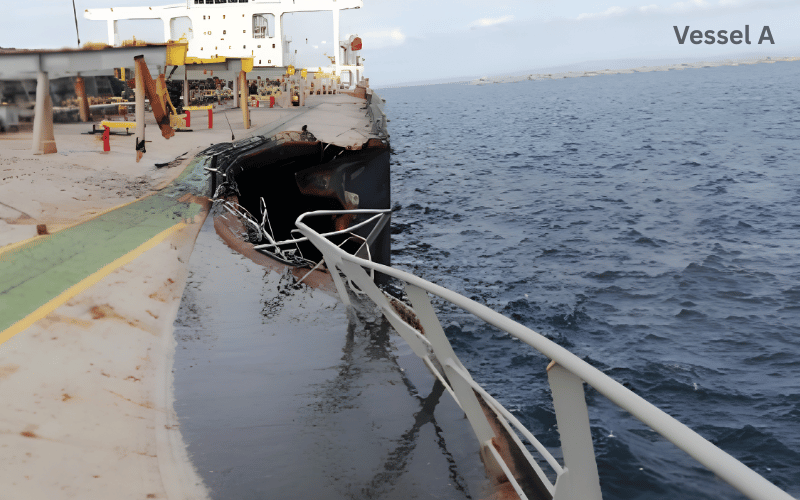
Vessel Traffic Services (VTS) contacted vessel A to instruct them to go to anchorage or drift, as visibility in the TSS was too low, and traffic was now suspended. A few minutes later, when the Master saw that the opposite traffic lane was free, he ordered slow ahead on the engine and port helm to cross the lane to comply with the suspension order. The VTS agreed with this alteration, but the VTS operator was also ignorant of the exact position of vessel B, since there was no AIS transmission and the vessel’s radar return was intermittent.
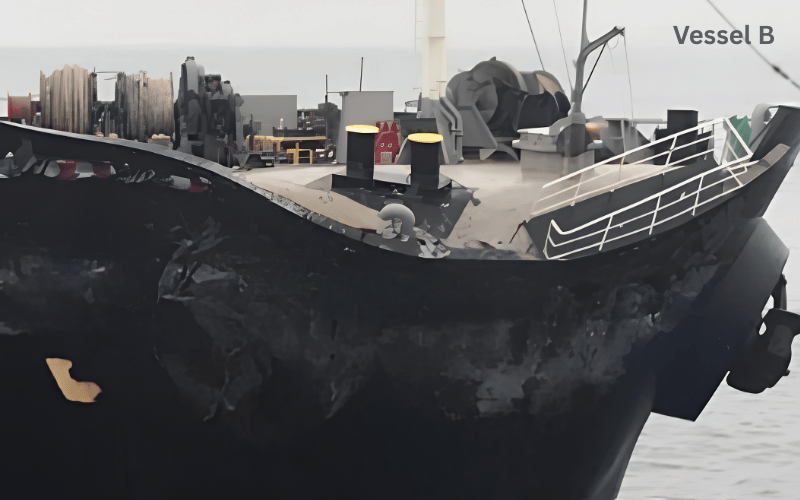
The OOW on vessel B became concerned about the developing close quarters situation and called vessel A on the VHF. Vessel A responded, but there was no follow-up conversation. Within seconds, the two vessels were in sight of one another. The Master of vessel A, now realising that vessel B was close behind, ordered hard to starboard to avoid a collision. On vessel B, the OOW put the helm hard to port, but a collision was now inevitable, and they struck vessel A on its port side. Damage was significant on both vessels.
Lessons Learned
- AIS is an important watchkeeping tool but not foolproof. Overreliance on AIS targets on your radar can damage your situational awareness.
- ARPA and AIS are complementary systems, and in restricted visibility all contacts – whether AIS-equipped or not – must be tracked on radar.
- Speed in restricted visibility must reflect the stopping capability relative to visible range. Vessel B was making 11.8 knots in dense fog in a congested TSS. At that speed and at close range to another vessel, minimal time for collision avoidance was available.
- Bridge team composition must reflect actual conditions, not watch schedule defaults.
- Even adequate bridge team composition when in reduced visibility, as with vessel A, is not a failsafe for faultless operations. In the case of vessel A, BRM and bridge team situational awareness were less than adequate, thus negating the effect of a reinforced bridge team.
Read on the original site
Open the publisher's page for the full experience