World’s First Ship-to-Ship Ammonia Bunkering To An Ammonia-Fueled Vessel Completed
Our take
The successful completion of the world’s first ship-to-ship ammonia bunkering operation represents a significant milestone in the maritime industry’s decarbonization efforts. NYK Line’s achievement, alongside its Japanese partners, underscores the accelerating shift toward alternative fuels as the sector grapples with increasingly stringent environmental regulations and a growing imperative to reduce its carbon footprint. This development builds upon previous advancements, such as the recent approval from American Bureau of Shipping for Hanwha Power’s 22,000 m³ LNG bunkering ship concept featuring LNG-ammonia dual-cargo capabilities New 22,000 m³ LNG Bunkering Ship Concept Receives AiP from American Bureau of Shipping, demonstrating a concerted effort to establish the necessary infrastructure for ammonia as a viable marine fuel. The broader context of this progress is further highlighted by the increasing scrutiny of CO2 emissions from maritime transport, as evidenced by research examining the relationship between ICT development and emissions ICT development and maritime transport CO2 emissions: evidence from cross-country panel data, emphasizing the need for rapid and validated technological solutions.
The complexities of transitioning to ammonia fuel are substantial, requiring not only advancements in engine technology and fuel storage but also the development of robust and safe bunkering infrastructure. Ship-to-ship transfer, as demonstrated by NYK Line, offers a pragmatic approach to scaling ammonia availability, avoiding the need for every port to immediately retrofit infrastructure. However, it's crucial to acknowledge the challenges inherent in ammonia handling, including its toxicity and potential for leaks. Calibrated risk assessments and rigorous safety protocols, validated through empirical data, are paramount to ensuring operational integrity. The recent operation’s success provides valuable, longitudinal data that can inform the refinement of these protocols and accelerate broader adoption. The precedent set by this bunkering operation reinforces the importance of integrated data ecosystems, allowing for real-time monitoring and predictive maintenance to mitigate potential hazards. We also see related progress in LNG bunkering, as exemplified by the Port of Tenerife’s first multi-truck LNG refuel Baleària Fast Ferry Receives Port Of Tenerife’s First Multi-Truck LNG Refuel, highlighting the ongoing diversification of alternative fuel strategies.
Beyond the immediate technological implications, this event signals a crucial shift in the maritime industry’s mindset. The willingness to invest in and execute complex ship-to-ship operations underscores a commitment to long-term sustainability and a recognition that innovative solutions are essential for navigating the evolving regulatory landscape. The speed of this transition will be influenced by a variety of factors, including the cost competitiveness of ammonia compared to traditional fuels, the development of robust supply chains, and the ongoing refinement of safety standards. Peer-reviewed research and transparent data sharing are critical to accelerating progress and ensuring that these solutions are both effective and sustainable. The integrated nature of this effort, involving multiple stakeholders across the value chain, exemplifies the collaborative spirit needed to address global challenges.
Looking ahead, the focus will undoubtedly shift to scaling up ammonia production and distribution networks. While initial adoption may be concentrated in specific regions with existing infrastructure or supportive policies, the long-term viability of ammonia as a marine fuel hinges on its global availability and affordability. A key question remains: how can we ensure that the transition to ammonia, and other alternative fuels, is equitable and doesn't disproportionately impact developing nations that rely on maritime transport for their economic prosperity? The data generated from these early operations will be invaluable in informing policy decisions and guiding future investments in ocean intelligence and infrastructure, ultimately shaping the future of maritime decarbonization.
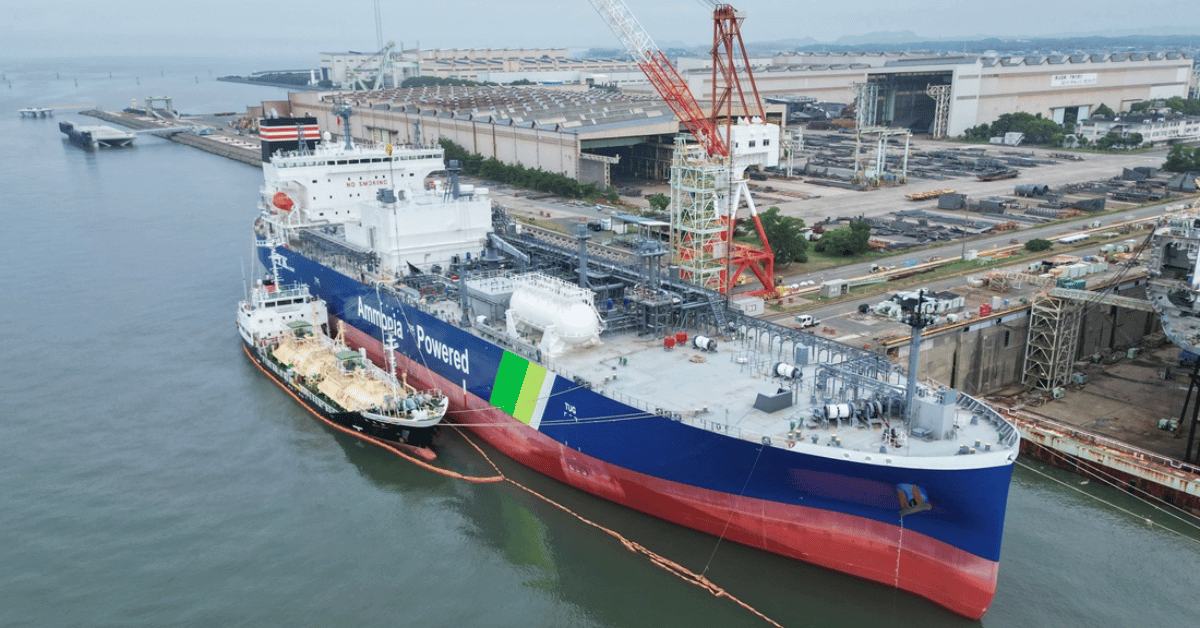
NYK Line, with Japan Marine United Corporation, Nihon Shipyard Co., Ltd., Mitsubishi Gas Chemical Company, Inc., and Kokuka Sangyo Co., Ltd., has completed the world’s first ship-to-ship (STS) ammonia bunkering operation to an ammonia-fueled vessel on September 17.
At a quay within Japan Marine United Corporation’s Ariake Shipyard, ammonia fuel was transferred from the ammonia carrier Shoei Maru via the STS method to an ammonia-fueled medium gas carrier (AFMGC) scheduled for delivery in November 2026.
The operation was conducted in preparation for sea trials of the AFMGC using fuel ammonia.
This achievement represents an important initiative that has put into practice an operation essential for the future practical deployment of ammonia-fueled vessels.
Ammonia is expected to play an important role as a next-generation marine fuel because it emits no carbon dioxide (CO₂) during combustion and can contribute to the decarbonization of international shipping. At the same time, its toxicity makes it difficult to handle, and establishing highly safe and reliable operations remains a challenge for practical use.
The bunkering operation was conducted following extensive discussions among the companies involved. Safe operating procedures and work processes were established prior to the operation, enabling the transfer to be completed safely. Through this initiative, we have accumulated practical insights regarding safe fuel supply operations.
This operation serves as a pioneering example of the fuel-supply framework that will be required for the widespread adoption of ammonia-fueled vessels. The AFMGC is currently in the final stage of construction and is scheduled for delivery in November 2026.
The successful completion of this operation marks a significant milestone toward the broader commercial use of fuel ammonia and the practical deployment of ammonia-fueled vessels. It also represents an important step forward in establishing an ammonia supply chain.
Press Release
Read on the original site
Open the publisher's page for the full experience