Cargo Ship Carrying 23 Indian Seafarers Catches Fire After Drone Strike En Route To Pakistan
Our take
The recent incident involving the MV BARYON, a cargo ship carrying 23 Indian seafarers, struck by a drone and subsequently catching fire en route to Pakistan, represents a deeply concerning escalation of risks within global maritime trade. Such an event highlights the vulnerability of critical supply chains and underscores the growing complexity of maritime security threats. This isn’t an isolated occurrence; recent events, such as the sinking of a Turkish cargo ship after a collision [Turkish Cargo Ship With 10 Crew Sinks Off Marmara Sea After Colliding With A Tanker], and the heightened focus on maritime cooperation in the Red Sea due to escalating regional tensions [Red Sea Nations Strengthen Maritime Cooperation as Regional Threats Grow], all point to a volatile and increasingly unpredictable operating environment for commercial shipping. The deliberate targeting of a vessel, regardless of its cargo or flag, introduces a new level of danger and demands immediate and comprehensive reassessment of maritime security protocols. It’s a stark reminder that geopolitical instability can rapidly translate into direct threats to commercial activity, with potentially far-reaching economic consequences.
The implications extend beyond the immediate safety of the crew and the loss of the vessel. The targeting of a commercial ship raises questions about the intent behind the strike – was it a targeted attack, collateral damage in a broader conflict, or an act of piracy employing increasingly sophisticated technology? The use of drones as offensive weapons in this context is particularly alarming, given their relatively low cost, ease of deployment, and potential for remote operation, making them difficult to detect and intercept. This incident echoes concerns previously raised regarding the potential for weaponized drones to disrupt maritime traffic, as evidenced by the ongoing discussions surrounding security in the Strait of Hormuz, including proposals to rename it [U.S President Donald Trump Suggests Renaming Strait Of Hormuz ‘Trump Strait’], a move indicative of the strategic importance and perceived vulnerabilities of key maritime chokepoints. The incident involving the MV BARYON demands a thorough investigation to determine the perpetrators and the motivation behind the attack, but it also requires a proactive response to mitigate the risk of similar incidents in the future.
The data surrounding maritime incidents, including this one, underscores the necessity for integrated data ecosystems capable of providing real-time ocean intelligence. Effective risk mitigation requires more than reactive measures; it demands a predictive capability that leverages empirical data and longitudinal analysis to anticipate and address emerging threats. This includes the development and deployment of advanced sensor technologies, enhanced maritime domain awareness systems, and improved information sharing between nations and stakeholders. The incident highlights the crucial role of calibrated risk assessments, informed by validated data, to ensure the safety and security of seafarers and the stability of global trade. Furthermore, the international community must collaborate to establish clear norms and regulations governing the use of drones in maritime environments, preventing their misuse and ensuring accountability for any violations.
Looking ahead, the vulnerability of commercial shipping to drone attacks presents a significant and evolving challenge. The question isn't *if* another such incident will occur, but *when* and where. The integration of autonomous technologies into maritime operations, while offering potential benefits in terms of efficiency and safety, also creates new attack vectors that must be addressed proactively. Continuous monitoring of climate indicators and geopolitical developments, combined with robust data analysis and adaptive security strategies, will be essential to safeguarding maritime trade in an increasingly complex and unpredictable world. How will international law and maritime security protocols adapt to effectively address this emerging threat, and what innovative technological solutions will be required to protect vessels and seafarers from drone-based attacks?
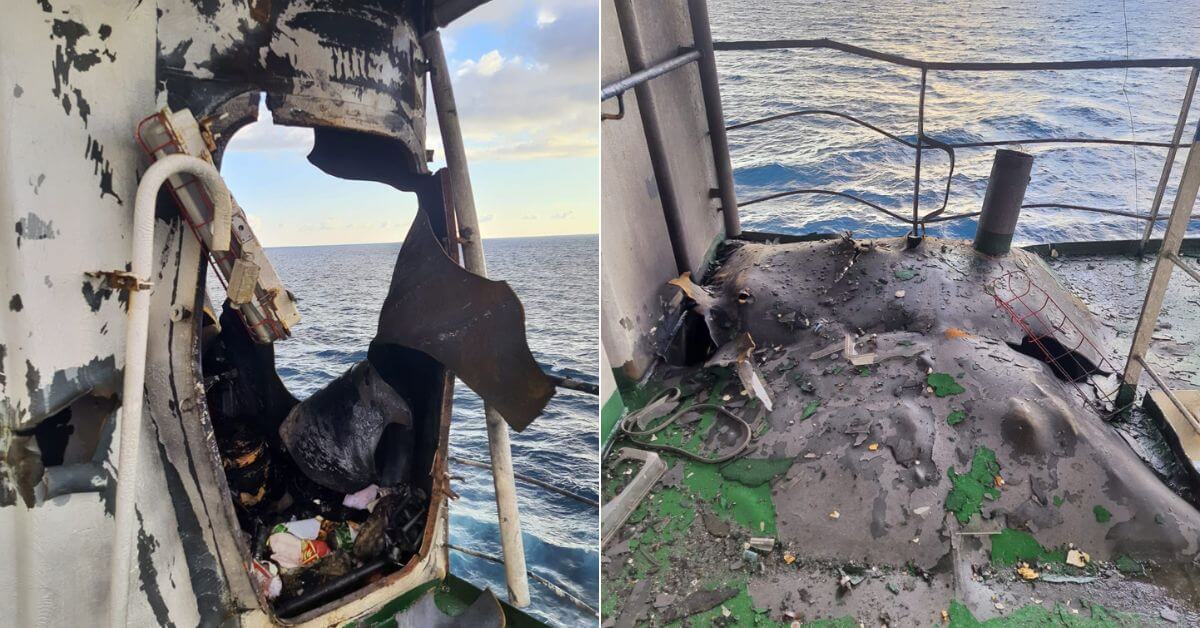
A cargo ship carrying 23 Indian sailors was hit by a drone while sailing from Russia to Pakistan on September 2, the Forward Seamen’s Union of India (FSUI) said.
The MV BARYON, IMO number 9151412, was sailing from the Russian port of Novorossiysk to Karachi when it was targeted.
The drone hit the accommodation area of the MV BARYON, causing a fire. The crew put out the fire, and the ship continued towards Karachi using its own engine.
All 23 Indian sailors onboard were reported safe.
A second drone was also seen during the incident, Manoj Yadav, general secretary of the FSUI, said. No injuries have been reported among the crew.
The FSUI shared photos and video showing the damage caused by the fire. The union said the Indian sailors were only doing their jobs and were not part of the conflict.
It asked India’s Ministry of External Affairs, Ministry of Ports, Shipping and Waterways and Directorate General of Shipping to check on the crew and confirm that they were safe.
The FSUI also called for better protection for Indian seafarers. It asked officials to ensure High Risk Area wages for the sailors and take up the issue with the country concerned.
@DroneAttack 2nd in the world. Not expendable.⁰Indian seafarers keep global trade moving. That is not a licence to kill them.
On 2 September 2026, MV BARYON (IMO 9151412) was struck by a drone while sailing from Novorossiysk to Karachi. The UAV hit the accommodation. Fire broke… pic.twitter.com/ICrL0P5Lx5
— FSUI (@FSUIINDIA) September 4, 2026
It is not known whether the MV BARYON was attacked in or near the Strait of Hormuz.
The incident follows several other cases involving commercial ships carrying Indian nationals.
On April 22, a vessel carrying 22 crew members, including 21 Indians, came under attack in the Strait of Hormuz.
The FSUI called it a distressing confrontation and said Iran’s Islamic Revolutionary Guard Corps (IRGC) carried out the attack.
On June 9, the U.S. military carried out a precision strike on the Palau-flagged oil tanker Settebello in the Gulf of Oman.
On July 24, a Mozambique-flagged LPG tanker carrying 28 Indian crew members was attacked in Iranian territorial waters. All the crew members were reported safe.
A senior shipping ministry official said two vessels were hijacked in separate incidents off Yemen and Somalia. A total of 22 Indian nationals were involved in those incidents.
On August 20, the Eritrea-flagged oil products tanker M.T. Sibu 1 was hijacked in the Gulf of Aden. The tanker had 20 crew members onboard, including 16 Indians. It was about 30 nautical miles from the Yemeni coast when it was hijacked, according to the official.
References: abplive, news18
Read on the original site
Open the publisher's page for the full experience