climate change impact
climate change impact on World Data Ocean: a running collection of 43 stories we have gathered and hand-picked because they are worth your time. Every post here touches on climate change impact in some way — the news, the analysis, the deep dives, and the occasional surprise find. A Global Hub for Ocean Intelligence 4 World Data Ocean is a centralized digital platform where researchers, scientists, and ocean enthusiasts converge to explore, analyze, and… New stories are added to this page as we find them, so check back if you want to keep up with what is happening around climate change impact, or subscribe to the RSS feed to get them as soon as they are published. Browse the collection below, or head back to the homepage to see everything World Data Ocean is covering right now.

High-accuracy fish species identification using transfer learning on vision foundation models
Citizen science initiatives are vital for large-scale monitoring of marine biodiversity, particularly in the Mediterranean Sea, a region facing significant ecological challenges. To improve the reliability of species observations from non-expert contributors, this study introduces MEDFISH101, a dataset of approximately 70,000 validated images of 101 fish species. Utilizing advanced transfer learning techniques, we developed a deep learning model, DINOv2-G, achieving a Top-1 accuracy of 94.12% in species identification.
A climate change profiteer? Temperature and light effects on primary production in non-native Vaucheria sp. turfs in the European Wadden Sea
Climate change significantly alters coastal ecosystems, particularly in the European Wadden Sea, where rising seawater temperatures have increased by nearly 2 °C over the past 60 years. This study investigates the effects of temperature and light on the primary production of the non-native yellow-green alga Vaucheria sp. under controlled conditions. Our findings reveal a broad thermal tolerance and strong photo acclimation capacity, suggesting that Vaucheria sp. may thrive amid regional warming.
Hurricane impacts on oyster reef habitat in a large, wind-driven estuary
Hurricanes significantly impact oyster reef habitats, particularly in large, wind-driven estuaries like Pamlico Sound, North Carolina. The unique conditions during Hurricanes Florence and Dorian allowed researchers to assess how storm characteristics, reef depth, and structure affect oyster populations. Findings revealed that deeper reefs faced severe degradation and mortality, while shallower, sheltered reefs showed resilience. Effective management and restoration efforts must consider these factors to enhance reef resilience against increasing storm frequency and intensity.
Impacts of coinciding ocean acidification and warming on the fatty acid profile of the pteropod Limacina helicina within the Northeast Pacific coastal region
Under global climate change, the co-occurrence of ocean acidification (OA) and warming presents significant threats to marine ecosystems, particularly in the Strait of Georgia, where aragonite undersaturation is prevalent year-round. This study investigates the impacts of these conditions on the fatty acid profile and survival of the pteropod Limacina helicina, a crucial component of local zooplankton communities. Findings reveal that short-term OA can alter fatty acid composition, potentially affecting nutritional quality and energy transfer within the ecosystem.
Short-term and long-term prediction of South China Sea SST based on multiple meteorological factors and machine learning
This study presents a machine learning-driven multivariate framework for predicting sea surface temperature (SST) in the South China Sea, integrating key meteorological factors to enhance forecasting accuracy. Unlike traditional univariate models, this approach utilizes multiple variables, including wind components, dew point temperature, and cloud cover, to capture complex, nonlinear relationships. Evaluating models such as Random Forest, XGBoost, and LightGBM, the research demonstrates that the Random Forest model achieves the highest accuracy for both short-term and long-term forecasts, emphasizing the importance of a multivariate input design.
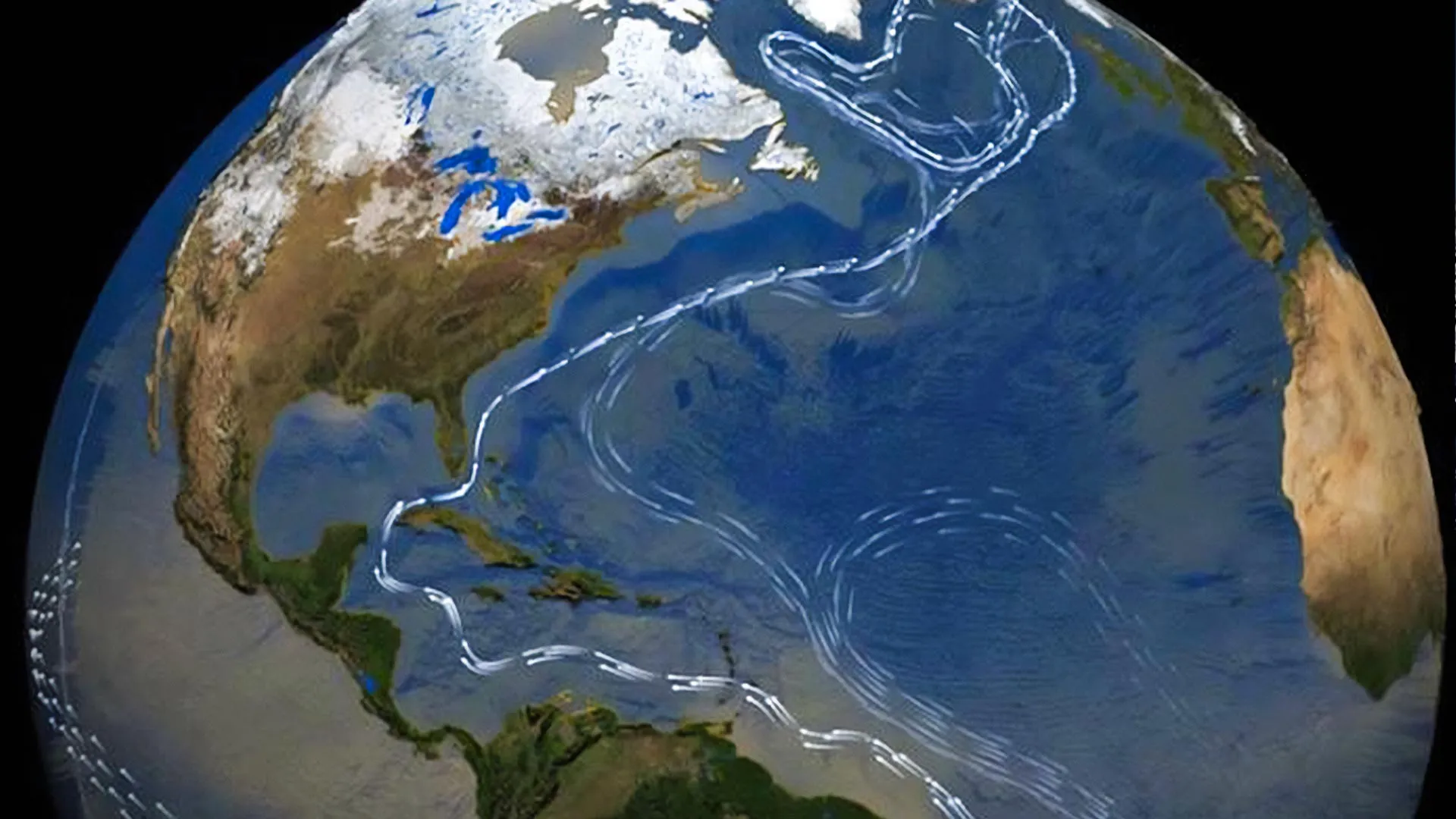
Scientists say a critical Atlantic ocean current is weakening and the world could feel the impact
Scientists have identified compelling evidence indicating that a key Atlantic Ocean current system, which plays a vital role in regulating global climate, is weakening. This significant slowdown has been observed over nearly two decades across a broad area of the North Atlantic. The implications of this change are profound, as this ocean circulation influences weather patterns and temperatures. Consequently, alterations to this system could lead to notable impacts on storms, rainfall distribution, sea levels, and winter conditions in regions of Europe and North America.
Sex-specific responses of intestinal health, microbiota composition, and transcriptome profiles in golden pompano (Trachinotus blochii) subjected to hypoxia and reoxygenation
Severe hypoxic events, exacerbated by climate change and coastal eutrophication, pose significant threats to marine ecosystems and commercially important species like the golden pompano (Trachinotus blochii). This study investigates the sex-specific physiological and microbial responses of golden pompano subjected to hypoxia and subsequent reoxygenation. By analyzing intestinal health, microbiota composition, and transcriptome profiles, we aim to enhance understanding of how each sex responds to environmental stress. Findings will inform targeted management strategies and nutritional interventions, vital for the sustainability of golden pompano aquaculture.
Subtle response in Arctic coastal benthos to environmental change - a case study from NE Kalaallit Nunaat (Greenland)
This study examines the subtle yet significant responses of Arctic coastal benthos to environmental change, highlighting a time-series analysis of epibenthic community structure in Young Sound, NE Kalaallit Nunaat (Greenland). By evaluating data collected from drop cameras and ROVs between 2003-2010 and 2021-2022, the research reveals notable shifts in taxonomic and functional composition, with brittle stars and bivalves dominating the community.
Integrating climate storylines and time of emergence on vulnerability assessments: the case of crested penguins
This study explores the vulnerability of crested penguins to ocean warming by integrating innovative climate assessment tools—storylines and time of emergence. As anthropogenic climate forcing alters ocean circulation in the Southern Ocean, understanding the impacts on these threatened species becomes increasingly complex due to uncertainties in climate projections.

Climate change impacts - NOAA (.gov)
Climate change poses significant challenges across various ecosystems, profoundly affecting weather patterns, sea levels, and biodiversity. The National Oceanic and Atmospheric Administration (NOAA) provides crucial insights into these impacts, highlighting the empirical data and longitudinal studies that inform our understanding of climate-related changes. By synthesizing ocean intelligence and climate indicators, NOAA emphasizes the urgent need for global collaboration in addressing these challenges. Understanding these impacts is essential for effective stewardship and fostering a collective responsibility toward preserving our planet’s health and future.

New Technologies And Approaches To Vessel Protection
As global shipping routes face heightened risks from geopolitical tensions and environmental challenges, the need for innovative vessel protection technologies and strategies has never been more critical. New approaches leverage advanced data analytics, real-time monitoring, and integrated systems to enhance maritime safety and security. By fostering collaboration among stakeholders, these technologies not only safeguard vessels and seafarers but also contribute to a more resilient global shipping industry. Embracing these advancements is essential for navigating the complexities of today's maritime landscape effectively.
Decomposing tropical Pacific air-sea CO2 flux anomalies during marine heatwaves and cold spells: thermal versus non-thermal drivers
This study investigates the influence of marine heatwaves (MHWs) and marine cold spells (MCSs) on air-sea CO2 flux anomalies in the tropical Pacific, a region significantly impacted by extreme thermal events. Analyzing multi-source observations and machine-learning models from 1990 to 2019, the research reveals that MHWs enhance oceanic CO2 uptake by approximately 0.53 mol C m⁻² yr⁻¹, while MCSs reduce it by around 0.28 mol C m⁻² yr⁻¹. Key findings
Gray whales (Eschrichtius robustus) in San Francisco Bay experience high mortality and have limited affiliation to known foraging groups
Gray whales (Eschrichtius robustus) in San Francisco Bay face significant mortality risks and demonstrate limited connections to known foraging groups. As climate change alters food webs, these whales, particularly the Eastern North Pacific population, encounter increased human activities and associated hazards. Since 2018, novel migration patterns have led gray whales to utilize SF Bay, prompting a study of subgroup identity and mortality rates from 2018 to 2025.
A holistic perspective on planktonic communities across the Northwestern Mediterranean Sea
The Northwestern Mediterranean Sea is experiencing significant environmental changes due to climate variability and human activities. To assess the long-term impacts on marine ecosystems, the Mediterranean Ocean Observing System for the Environment (MOOSE) program employs multidisciplinary observations, integrating physical, chemical, and biological data. This study offers a comprehensive evaluation of planktonic communities, utilizing environmental genomics and high-resolution imaging across various plankton size fractions and depths.
Under pressure: accounting for multiple human pressures outside and inside marine protected areas in the Skagerrak
The cumulative effects of multiple human pressures pose significant threats to marine ecosystems in the Skagerrak. This initial spatial assessment mapped the intersection of 20 distinct pressures with 39 sensitive habitats and species, revealing critical areas of concern. Notable hot spots of high human impact, particularly in shallow regions, were identified alongside cold spots with minimal disturbance.
High resolution seafloor photogrammetry indicates long-term persistence of a sulphophilic community on a whale fall in the NE Pacific
High-resolution seafloor photogrammetry reveals the long-term persistence of a sulphophilic community on a whale fall in the NE Pacific, highlighting its significance as a biodiversity hotspot. A 15-year time-series study of a blue or fin whale skeleton at 1288 meters depth on the Clayoquot Slope assessed ecosystem changes using ROV surveys. Findings indicate minimal structural degradation of the skeleton and an increase in bacterial mat coverage, alongside a rich benthic megafaunal community.
Windstorms increase benthic-pelagic coupling and nutrient outwelling from shallow coastal wetlands
Windstorms significantly enhance benthic-pelagic coupling and nutrient outwelling from shallow coastal wetlands, with implications for coastal ecosystems. This study examines the effects of a windstorm event (WSE) on biogeochemical characteristics in the inner Cadiz Bay, Spain, focusing on sediment types and their responses. We observed transient increases in total suspended solids (TSS), chlorophyll a (Chla), and dissolved inorganic nutrients in the water column during the WSE.
Nutrient dynamics in the Yellow River Estuary: influencing factors and ecological impacts
The Yellow River Estuary has faced significant ecological challenges, including eutrophication and red tides, driven by human activities and climate change. This study analyzes nutrient dynamics from 2004 to 2023, revealing notable seasonal variations in dissolved inorganic nitrogen (DIN), dissolved inorganic phosphorus (DIP), and dissolved inorganic silicon (DSi). Autumn maxima were observed for DIN and DIP, while DSi peaked in summer, influenced by terrestrial inputs and biological activities.

Laser satellites expose a secret Antarctic carbon burst
A groundbreaking study utilizing laser satellite technology and AI analysis has unveiled a significant increase in carbon dioxide emissions from the Southern Ocean during winter, revealing that prior estimates may have underestimated these emissions by 40%. For the first time, scientists can observe and quantify carbon release in the polar darkness, fundamentally altering our understanding of the ocean's carbon balance.