World’s Largest Battery-Electric Ship Arrives In Uruguay For Commissioning
Our take
The arrival of Hull 096, the world's largest battery-electric ship, in Uruguay for commissioning marks a significant, albeit incremental, step toward decarbonizing maritime transport. The vessel’s journey from Tasmania, facilitated by the MV Black Marlin, underscores the logistical complexities inherent in deploying such advanced technology. This development arrives at a time when the vulnerabilities of global supply chains are sharply in focus, as evidenced by the recent constraints imposed on the Panama Canal [Panama Canal Squeezes Daily Capacity To 29 Ships, Threatening Global Supply Chains]. Furthermore, the tragic incidents involving passenger ferries, such as the sinking of the Virgo Transport 8 [Indonesian Ferry Carrying 243 Sinks In Java Sea Leaving One Dead And 140 Missing] and the fire aboard the MV June Aster [Video: 5 Dead, Dozens Missing After Passenger Ferry Catches Fire Off Philippines], serve as stark reminders of the critical need for safer, more sustainable maritime operations. While passenger ferries and cargo vessels operate under different regulatory frameworks, both highlight the risks associated with aging infrastructure and the imperative for innovative solutions.
The shift towards battery-electric propulsion in shipping, though promising, faces considerable hurdles. The energy density of batteries remains a limitation, particularly for long-haul voyages. While Hull 096’s specific operational profile hasn’t been fully detailed, its size suggests that it’s unlikely to be a transoceanic vessel currently. The environmental impact of battery production and disposal also requires careful consideration and a commitment to responsible sourcing and recycling practices. This underscores the importance of a holistic, life-cycle assessment approach to evaluating the true sustainability benefits of electric shipping. The deployment of this vessel in Uruguay, a region increasingly focused on renewable energy, suggests an opportunity to integrate the ship’s operations with local power grids, further minimizing its carbon footprint. Integrated data ecosystems, capable of monitoring and optimizing energy usage in real-time, will be crucial for maximizing the efficiency of these systems.
Beyond the immediate environmental benefits, the adoption of electric ships can contribute to improved operational efficiency and reduced noise pollution. Electric motors offer greater control and responsiveness compared to traditional combustion engines, potentially leading to smoother voyages and reduced fuel consumption. The reduction in noise pollution is particularly beneficial for marine ecosystems, minimizing disturbance to marine life and contributing to a healthier ocean environment. Longitudinal data collection and empirical validation of these benefits will be essential for building a robust case for wider adoption. The calibrated assessment of these effects, alongside the technological advancements being made in battery technology and charging infrastructure, will be critical in determining the long-term viability of electric shipping as a mainstream solution. The industry needs validated, measurable data to inform future investments and policy decisions.
Looking ahead, the success of Hull 096 will depend on its operational performance and the scalability of the underlying technology. The development of standardized charging infrastructure at ports worldwide is essential to facilitate the widespread adoption of electric ships. Furthermore, ongoing research into alternative battery chemistries and energy storage solutions, such as hydrogen fuel cells, will be critical for extending the range and capabilities of electric vessels. A key question remains: how quickly can the integrated data ecosystem required to manage and optimize these complex systems be developed and deployed globally, ensuring that the promise of sustainable maritime transport is fully realized?
The world’s largest battery-electric ship has arrived in Uruguay after travelling thousands of miles from Tasmania.
The vessel will now undergo testing before it starts operating between Uruguay and Argentina.
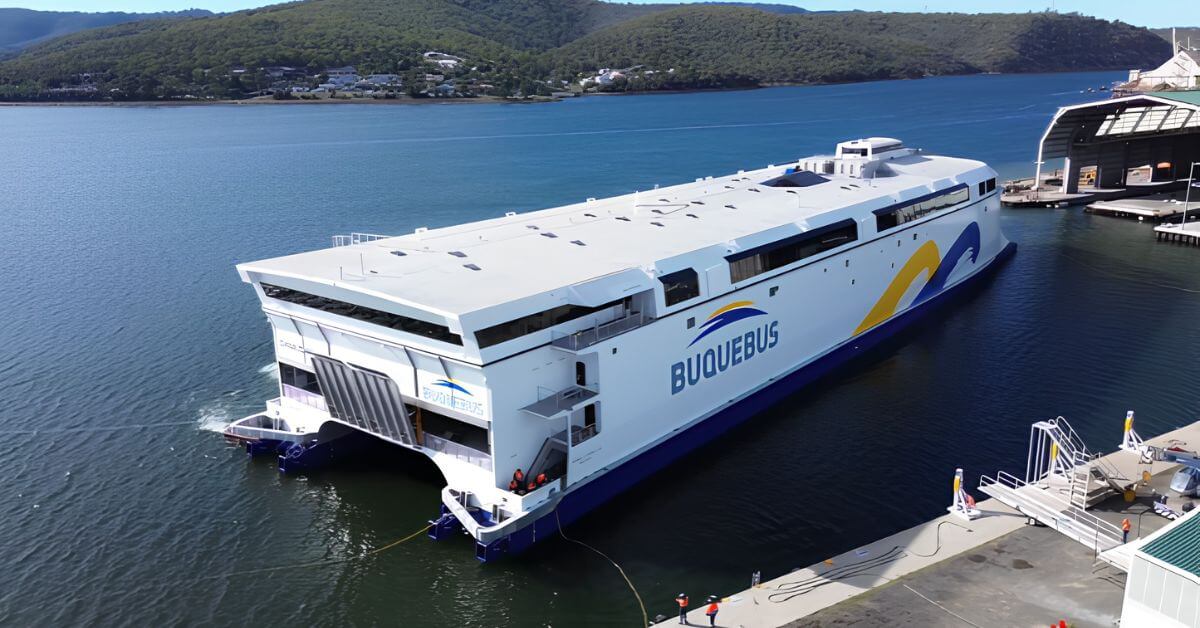
The 426-foot (130-metre) ferry, known as Hull 096, arrived at Nueva Palmira on Friday, September 11, aboard the heavy-lift ship MV Black Marlin. It was floated off the ship over the weekend.
The ferry will now be towed to Colonia del Sacramento, where it will go through commissioning and testing.
Hull 096 was built by Australian shipbuilder Incat for South American ferry operator Buquebus. It will carry passengers and vehicles between Colonia del Sacramento in Uruguay and Buenos Aires in Argentina.
The route across the Rio de la Plata is about 30 nautical miles and takes around one hour. The ferry is expected to make three crossings a day.
The vessel will operate under the name China Zorrilla, named after the late Uruguayan film and theatre actress who died in 2014.
Hull 096 can carry up to 2,100 passengers and 225 vehicles. It is powered by more than 5,000 battery modules and has a battery capacity of 40 megawatt-hours (MWh).
The batteries can power the ferry for about 90 minutes. This gives it enough endurance for its planned one-hour crossing between Uruguay and Argentina.
Hull 096 left Tasmania in early August after a multi-day operation on Hobart’s River Derwent to load it onto the MV Black Marlin.
The loading operation was described as one of the most complex marine operations in Tasmania’s history.
The heavy-lift ship then carried the ferry past the northern tip of New Zealand, across the Pacific Ocean and around South America’s Cape Horn before reaching Uruguay.
After the arrival, Hull 096 was welcomed at a ceremony in Nueva Palmira. Incat called the arrival a significant milestone for the company.
The company also said the vessel was “a major step forward in the transition to cleaner, more sustainable maritime transport”.
Hull 096 is made from aluminium. Incat said the material helps reduce the vessel’s weight and improves the efficiency of its battery-electric propulsion system.
The ferry has eight electric waterjets. Its propulsion, handling, control systems and manoeuvrability were tested during harbour trials in Tasmania.
The vessel has a capacity of 40 MWh and can operate for about 90 minutes on its batteries.
Its capacity is four times that of any maritime vessel built before it, according to the information provided by Incat.
Buquebus first ordered the ferry in 2019. Construction was later paused during the COVID-19 pandemic.
The vessel was then redesigned from diesel propulsion to a fully electric system.
Hull 096 was launched into Tasmania’s River Derwent in May 2025. It later went through testing and commissioning before being prepared for its journey to South America.
Incat Chairman Robert Clifford thanked the people who worked on the project.
References: interestingengineering, abc
Read on the original site
Open the publisher's page for the full experience