Video: Ukrainian Naval Drone Hits Russian Offshore Support Ship In Sochi
Our take
The recent reported strike on the Nefrit, a Russian offshore support ship operating in Sochi, represents a significant escalation in the ongoing conflict and highlights the evolving nature of naval warfare. The use of a Ukrainian naval drone to target a vessel of this type—a multipurpose ship vital for oil and gas operations and personnel transport—underscores a shift towards asymmetric warfare tactics. This incident follows on the heels of increasing investment in shipbuilding globally, as evidenced by [Maersk Eyes Investment In Bangladesh Shipbuilding, With Ship Recycling Also On Agenda], reflecting a broader strategic focus on maritime capabilities. The ability of Ukraine to project force into Russian territorial waters, even with relatively low-cost unmanned systems, challenges conventional notions of naval dominance and introduces new vulnerabilities for maritime infrastructure. It also demonstrates the potential for disruptions to energy supplies and commercial shipping lanes, impacting regional and potentially global economies.
The targeting of the Nefrit, while not a direct assault on a major warship, carries considerable symbolic weight. Sochi is a strategically important location, hosting key Russian infrastructure and serving as a showcase for national prestige. Damaging a support vessel in this area sends a clear message of Ukraine’s reach and resolve. This event is particularly relevant given the concurrent shifts in global port operations, where [China’s Ningbo-Zhoushan Port Overtakes Singapore To Become World’s Second-Largest Container Port] illustrates the growing importance of efficient and secure maritime transit routes. Any instability in key regional waters, like the Black Sea, can have cascading effects on global trade and supply chains. Furthermore, the ongoing development of port infrastructure, as seen in the [ $434 Million Deal Signed Between France & Saudi Arabia For New Terminal At Jeddah Islamic Port], highlights the substantial investment nations are making in maritime capabilities, suggesting a heightened awareness of the strategic importance of sea lanes.
The implications of this attack extend beyond the immediate geopolitical landscape. The success of the Ukrainian drone strike validates the increasing utility of unmanned systems in naval operations. These systems offer a relatively inexpensive and low-risk means of conducting reconnaissance, surveillance, and even offensive actions against larger, more heavily armed adversaries. This trend is likely to accelerate the development and deployment of similar technologies by other nations, fundamentally altering the balance of power at sea. The incident also raises questions regarding the effectiveness of current Russian naval defenses and the vulnerability of offshore infrastructure to such attacks. The relatively limited response, if verified, suggests a potential weakness that could be exploited in future engagements. The ability to precisely target and disable a support vessel, even one not directly involved in combat operations, demonstrates a level of sophistication in Ukrainian intelligence and drone technology that warrants close observation.
Looking ahead, the continued evolution of unmanned naval systems and their deployment in conflict zones presents a complex challenge for maritime security. The proliferation of these technologies, coupled with the demonstrated effectiveness of asymmetric tactics, necessitates a reevaluation of traditional naval strategies and defensive measures. The incident involving the Nefrit serves as a stark reminder that the sea is no longer a domain solely defined by large warships and traditional naval power. The integration of ocean intelligence – the ability to gather, analyze, and act upon real-time maritime data – will become increasingly critical for maintaining stability and protecting critical infrastructure. A key question moving forward is how nations will adapt their maritime defenses to counter the growing threat of low-cost, high-impact unmanned systems operating in contested waters.
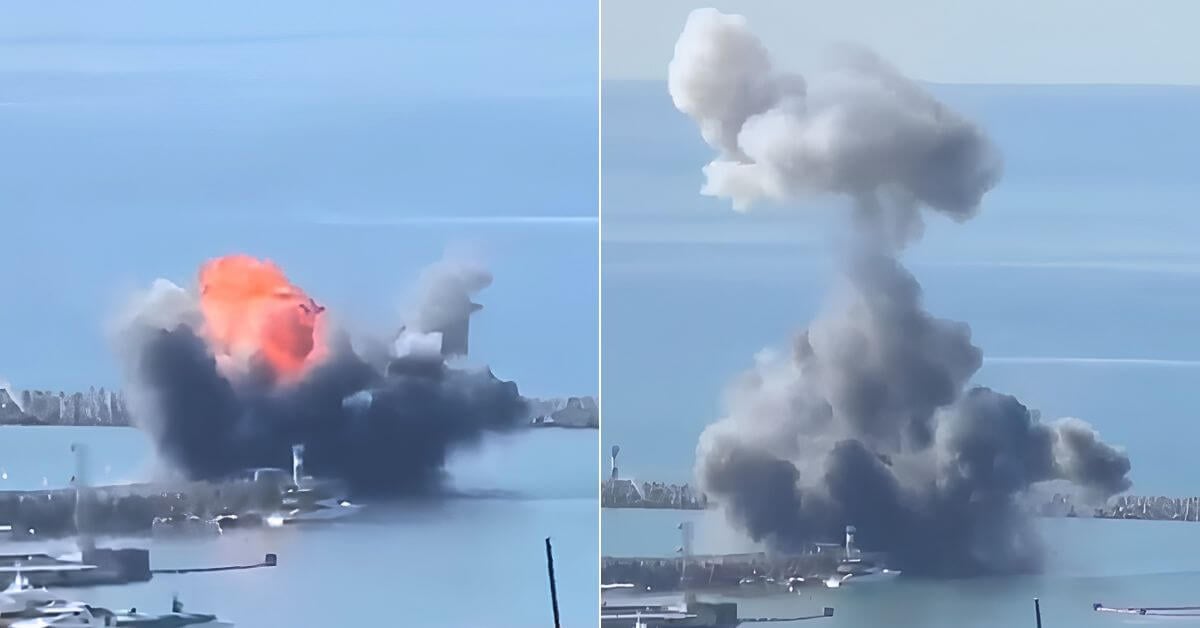
Ukrainian Navy said it destroyed a Russian-flagged support vessel with a naval drone in the port of Sochi on Sept. 3. The vessel, Nefrit, was hit by an unmanned surface vessel (USV).
Nefrit is a multipurpose support ship used for oil and gas operations, offshore facilities, cargo and personnel transport, and underwater technical work.
The attack was part of a series of Ukrainian attacks on Sochi on Sept. 3-4. Ukraine said the attack damaged Russian logistics and specialised maritime equipment linked to its maritime and energy infrastructure.
Video released by the Ukrainian Navy showed an explosion and smoke near the vessel.
Explosions Reported in Sochi
Several explosions were reported in Sochi during the attacks.
Sochi Mayor Andrey Proshunin warned residents at about 6 a.m. local time on Sept. 3 that there was a threat of a USV attack.
About 30 minutes later, he issued an all-clear. He did not give details about what had happened.
Several separate reports said an explosion took place near a Russian Pantsir air defence system at the port.
Later that night, videos posted by several Russian Telegram channels appeared to show a fire at an oil depot following an aerial attack.
The moment of today’s explosion of a Ukrainian surface kamikaze drone next to a Russian ship in Sochi. pic.twitter.com/zpavwj97BW
—
MilitaryNewsUA
(@front_ukrainian) September 3, 2026
Long-Range USV Strike
The attack on Nefrit was one of the farthest reported Ukrainian USV strikes against a Russian target in the Black Sea.
Sochi is about 350 miles from the nearest Ukrainian-held territory in a direct line. A USV travelling from Ukrainian-held shores would have to travel farther by sea.
The attack appears to be the first known Ukrainian USV strike on Sochi. The city has previously been targeted by Ukrainian aerial drones.
Ukraine has used naval drones against other Russian targets in the Black Sea.
In 2023, a Ukrainian USV struck the Russian Ropucha-class vessel Olenegorsky Gornyak in the port of Novorossiysk.
Ukraine Has Also Targeted Russian Vessels
In July, Ukrainian forces struck dozens of Russian vessels in the Black and Azov seas. The targets included tankers and other vessels that Kyiv identified as part of Russia’s shadow fleet.
Ukraine said it struck 13 vessels on July 21-22. They included 10 cargo ships, 2 tugboats and a tanker.
Russia’s shadow fleet is made up of vessels used to transport sanctioned Russian oil while hiding ownership to avoid Western sanctions.
A Ukrainian government register identified more than 1,400 such vessels as of May 2026. Many are older ships registered under third-country flags.
ВМС України уразили судно забезпечення рф NEFRIT у порту Сочі
Багатоцільове судно забезпечення під прапором рф було уражене морським безекіпажним катером Військово-Морських Сил. У районі судна зафіксовано потужний вибух та задимлення.Детальніше https://t.co/DTfnO15nYO pic.twitter.com/yPDFkks37r
— Військово-Морські Сили ЗС України (@UA_NAVY) September 3, 2026
Why Sochi Matters
Sochi is a major Russian resort city on the Black Sea. Russian President Vladimir Putin often visits the city, which is also home to his official summer residence.
The city is sometimes called Russia’s “Second Capital” and is a popular winter destination for Russia’s elite.
The Ukrainian Navy said the attack showed that Russian territory was not a safe haven and said it would continue targeting resources used to support the war.
Separately, on July 24, Ukraine’s Navy received NATO-certified authority to command multinational mine countermeasure forces.
Ukraine received the certification after completing a NATO Evaluation Level 2 assessment during the Sea Breeze 2026 exercises.
References: kyivindependent, militarnyi
Read on the original site
Open the publisher's page for the full experience