Pluto has landslides
Our take
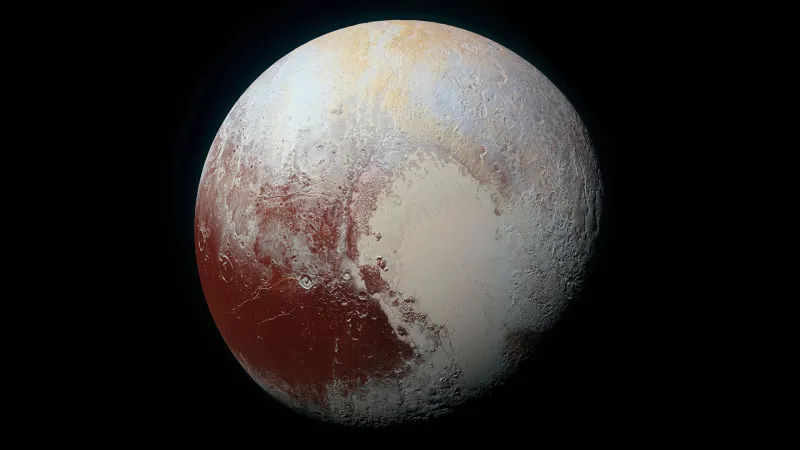
The recent discovery of six confirmed landslides on Pluto, revealed through New Horizons data, represents a significant advancement in our understanding of this distant dwarf planet’s geological activity. While the presence of geological processes on icy bodies was previously suspected, direct observation and confirmation, particularly of phenomena like landslides, provides crucial empirical data to validate existing models of Pluto's internal structure and surface dynamics. This finding underscores the importance of continued robotic exploration – a sentiment echoed by recent advancements in maritime technology, such as the Royal Navy Achieves World’s First Airborne Launch Of Uncrewed Boat For Maritime Missions, demonstrating innovative approaches to data gathering in challenging environments. Furthermore, the increasing reliance on data-driven insights, as highlighted by the World Economic Forum’s assessment of Ocean data is changing how we see the sea. Here's how - The World Economic Forum, parallels the meticulous data analysis required to interpret observations from missions like New Horizons and demonstrates a broader trend towards leveraging integrated data ecosystems for scientific advancement.
The landslides themselves are compelling evidence of ongoing, albeit slow, geological activity on Pluto. Their presence along crater rims suggests a mechanism of collapse driven by either sublimation (ice directly transforming to gas) or, potentially, cryovolcanism – the eruption of icy materials. The specific characteristics of the landslides, including their morphology and distribution, offer valuable insights into the composition of Pluto's icy crust and the prevailing environmental conditions. The fact that these features remained relatively undisturbed since their formation also speaks to a potentially quiescent, yet dynamic, geological landscape. This contrasts with earlier assumptions about smaller, icy bodies being essentially frozen and geologically inert. The insights gained from studying Pluto’s surface can be extrapolated to better understand similar phenomena occurring on other icy moons and dwarf planets throughout the outer solar system, contributing to a more comprehensive model of planetary evolution in extreme environments. It’s also worth noting that the prolonged operational deployments of assets like the US Navy Supercarrier Abraham Lincoln Spends Over 210 Days At Sea Without Any Port Call Since Dec 2025 highlight the robustness and reliability of modern technologies necessary for long-duration, data-intensive scientific missions, even in harsh operational conditions.
The discovery also reinforces the value of long-term, longitudinal data collection. New Horizons, despite having completed its primary mission flyby of Pluto, continues to provide valuable data as scientists refine their analysis techniques and develop new interpretive models. This underscores the importance of archiving and making available raw scientific data for future generations of researchers – an inherent element of maintaining a robust and validated scientific record. The ability to revisit and re-analyze data with improved tools and a deeper understanding is critical for maximizing the return on investment from space exploration missions. Furthermore, it emphasizes the interconnectedness of scientific disciplines; geological observations on Pluto can inform models of cryospheric processes relevant to Earth's polar regions, and vice versa.
Looking ahead, the question becomes: What other geological surprises does Pluto hold? Future missions, perhaps involving orbiters capable of more detailed mapping and compositional analysis, could reveal evidence of active cryovolcanism, tectonic activity, or even subsurface oceans. The confirmed presence of landslides provides a strong impetus for prioritizing the study of Pluto and similar icy worlds, as they represent vital laboratories for understanding the diversity of planetary processes and the potential for habitability beyond Earth. The integrated data ecosystem we are building, leveraging both terrestrial and space-based observations, will be critical to unlocking these secrets and expanding our understanding of the cosmos.
Read on the original site
Open the publisher's page for the full experience