China’s 40,000-Ton Drone Carrier Enters Final Trials As GJ-21 Stealth Drone Reappears
Our take
The emergence of China’s 40,000-ton drone carrier, currently undergoing final trials, represents a significant shift in naval warfare capabilities and underscores the evolving nature of maritime power projection. This vessel, equipped with an electromagnetic aircraft-launch system (EMALS) capable of deploying fixed-wing drones like the GJ-21 stealth drone, signals a move beyond traditional carrier-based aviation and towards a more distributed and autonomous operational model. The implications extend beyond China’s immediate strategic goals, impacting the balance of power in the Indo-Pacific region and prompting a re-evaluation of naval defense strategies globally. The U.S. Navy, for instance, is actively managing its own carrier deployments, with the USS Theodore Roosevelt [U.S Navy Prepares Aircraft Carrier USS Theodore Roosevelt For Middle East Deployment To Relieve USS George Washington] preparing for a crucial deployment to relieve the USS George Washington, highlighting the ongoing demands on existing assets and the need for adaptive responses to emerging threats.
The integration of drone technology into naval operations offers several distinct advantages. Drones can perform reconnaissance and surveillance missions with reduced risk to manned aircraft, extend operational range, and potentially overwhelm enemy defenses with swarms of autonomous platforms. The EMALS system on this new Chinese carrier further enhances these capabilities, allowing for the launch of heavier and more sophisticated drones than previously possible. This development is occurring against a backdrop of continuous refinement of existing naval assets, as demonstrated by the USS Boxer [U.S Navy’s USS Boxer Slated For Up To $180 Million Overhaul After Middle East Deployment] slated for an overhaul following its deployment, reflecting the cyclical nature of maintaining a modern naval fleet. The deployment of the USS Abraham Lincoln [US Navy Aircraft Carrier Abraham Lincoln To Dock In Thailand After Record 200 Days At Sea] after an extended period at sea also underscores the logistical and operational challenges associated with maintaining persistent naval presence.
The Chinese carrier’s capabilities also raise questions about the future of naval warfare. Traditional aircraft carriers, while still formidable assets, are increasingly vulnerable to advanced anti-ship missiles and other emerging technologies. Drone carriers, with their potential for greater operational flexibility and reduced risk to personnel, could represent a more resilient and cost-effective approach to projecting naval power. The development is not simply about acquiring a new platform, but about implementing a broader shift in naval doctrine, one that leverages the advantages of unmanned systems to enhance situational awareness, strike capabilities, and overall operational effectiveness. The ability to rapidly deploy and recover drones from a dedicated carrier platform allows for persistent surveillance and response capabilities in contested maritime environments.
Looking ahead, the successful integration of drone technology into naval operations will depend on several factors, including the development of robust drone autonomy, secure communication links, and effective command-and-control systems. The refinement of drone swarm tactics and the ability to coordinate drone operations with manned assets will also be critical. The ongoing advancements in artificial intelligence and machine learning are likely to play a key role in enabling these capabilities. The question now is not *if* other nations will pursue similar drone carrier programs, but *when* and how they will adapt their own naval strategies to counter this evolving threat landscape. How will the development of autonomous underwater vehicles (AUVs) further complicate the maritime strategic picture in conjunction with this drone carrier capability?
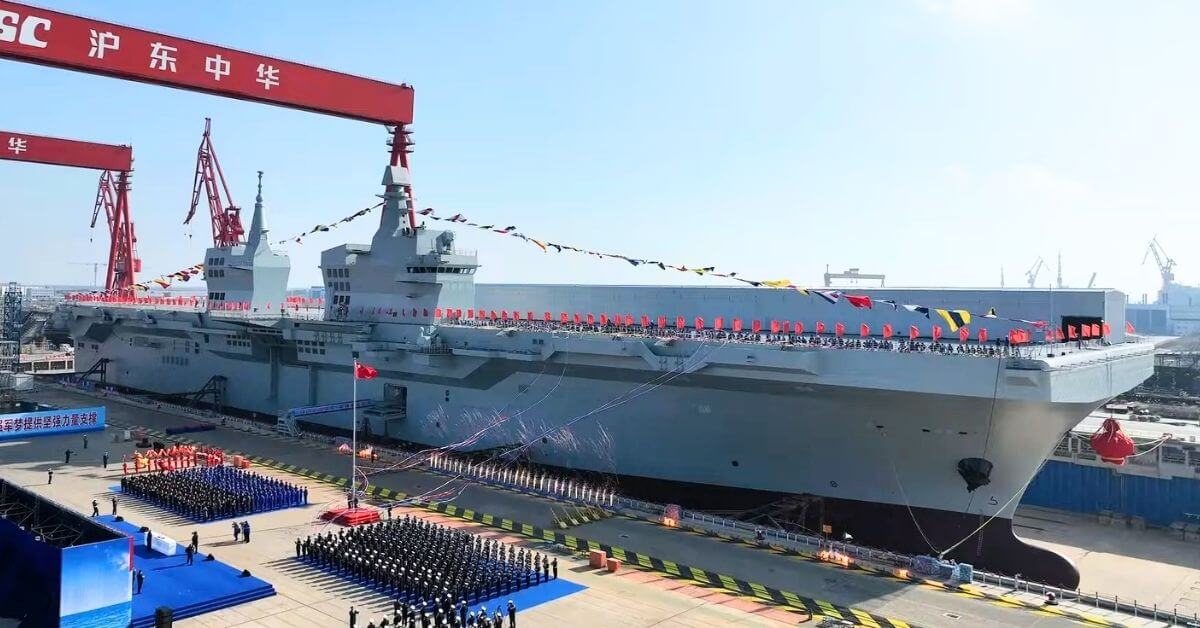
China’s new Type 076 amphibious assault ship, the Sichuan, has entered its final sea trials.
The Sichuan weighs more than 40,000 tonnes when fully loaded. It can carry troops, landing craft, aircraft and armoured vehicles.
The ship is fitted with an electromagnetic aircraft-launch system that could allow it to launch fixed-wing drones such as the GJ-21.
The GJ-21 is the naval version of China’s GJ-11 stealth attack drone. It was first shown publicly during China’s Victory Day parade in September 2025 and has only been seen publicly a few times since then.
A video posted on Chinese social media on Thursday showed the GJ-21 flying over a highway service area in Huludao, in northeastern China’s Liaoning province, according to the South China Morning Post.
Another video posted on Aug. 19 showed the drone flying over the same service centre from a different direction. A third video posted on Thursday showed it again from another angle.
China’s state broadcaster CCTV reported in July that the ship had entered its final testing phase. The PLA Navy is expected to receive the ship by the end of this year.
Most of the amphibious assault ships mainly operate aircraft and helicopters that can take off vertically or over short distances, such as the F-35B.
The Sichuan, however, has an electromagnetic catapult on its flight deck. The system is similar to the one used on the U.S. Navy’s Ford-class aircraft carriers.
The catapult could allow the ship to launch fixed-wing aircraft that cannot take off vertically, including large drones such as the GJ-21.
In July, CCTV showed computer-generated footage of the GJ-21 being launched from the Sichuan. Earlier this month, CCTV also showed the ship launching a red test vehicle using the system.
The Sichuan is expected to operate crewed and uncrewed fixed-wing aircraft and helicopters.
It has been described as the world’s first drone carrier and is the only amphibious assault ship fitted with an electromagnetic catapult system.
Other CCTV footage showed markings on the ship’s deck and the vessel deploying decoys during testing.
Satellite images shared on Thursday by X user MT Anderson appeared to show the Sichuan with two Type 052 destroyers and three Type 054 frigates near the Qingdao naval base on Aug. 25.
Qingdao is the headquarters of the PLA Northern Theatre Command navy.
The image, which the South China Morning Post said it could not independently verify, also appeared to show China’s first aircraft carrier, the Liaoning, nearby.
It was not clear why the ships were gathered in the area.
References: interestingengineering, scmp
Read on the original site
Open the publisher's page for the full experience